MacKay - Canadian Editorial Cartoons
mackaycartoons

Graeme MacKay's Editorial Cartoon Archive

  • Who?
  • Copyright
  • Boutique
  • Kings & Queens
  • Prime Ministers
  • Presidents
  • The French Monarchy Project
  • DOWNLOADS

climate change

5 Years of Riding the Waves of Annihilation

March 11, 2025 by Graeme MacKay

Happy Anniversary | March 11, 2025 | Newsletter 21

It’s been 5 years since I first published my editorial cartoon depicting the interconnected crises facing the world – from the COVID-19 pandemic to economic recession, climate change, and biodiversity collapse. This simple illustration has taken on a life of its own, spreading far beyond my original intent.

The cartoon was first published on March 11, 2020, the same day the World Health Organization declared COVID-19 a global pandemic. It showed two large waves – one labeled “Coronavirus” and the other “Recession” – highlighting how the public health crisis was devastating the economy.
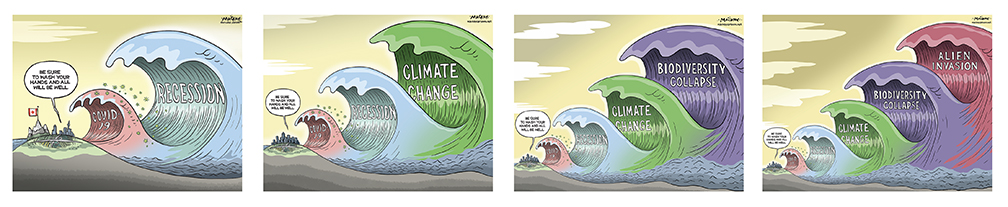
In the years that followed, the cartoon was widely shared, adapted, and modified by people around the world. Some faithfully recreated the image, while others added additional waves to represent other looming threats like climate change and biodiversity loss. A few even cheekily inserted their own agendas, like the Extinction Rebellion group that slapped their logo over the top.

It is my most published illustration ever.

It was highlighted in a lead article published in a special edition of Scientific American dedicated to the Coronavirus in March 2022. Not bad for someone who flunked Chemistry in high school. Take that, Mr. Bourrie!

The Green Spirits at Westminster

Tracking where this cartoon has appeared has been fascinating – from major publications to grassroots activist groups. In the UK, the “Four Waves” banner was proudly paraded through the streets of Torbay by the Green Spirits environmental group. Then in 2022, the same banner led a climate protest march in front of the UK Parliament.

However, this widespread use raises important questions about the respect for artistic work. While some individuals have sought permission and credited the original artist, many others have appropriated the image without acknowledgment. This disregard for creativity can diminish the original message behind the artwork.

This issue isn’t isolated to just me; many of my colleagues face similar vandalism when signed editorial cartoons are defaced, cropped, and transformed into memes that skew the original messaging of our commentary. This trend not only undermines our artistic integrity but also dilutes the intended impact of our work.

Adding to this challenge is the rise of artificial intelligence, which can hijack our hard work and produce lifeless imitations that lack the nuance and creativity of human artistry. This growing threat raises further concerns about the future of artistic expression and the value placed on original work. More on this topic will be explored in a future post.

Movements like Extinction Rebellion, despite their vital mission to raise awareness about climate change, have faced criticism for their lack of respect for artists’ rights. The reactions of those who alter creative works vary—some recognize their mistakes and offer apologies, while others insist they have the right to modify and share images as they please. This behaviour highlights the ongoing need for greater respect for artists and their creations in our increasingly digital landscape.

Ultimately, I decided it was time to update the cartoon myself, incorporating a fifth “zombie apocalypse” wave. This reflected the growing sense of apathy and inaction in the face of these mounting crises. As one insightful commenter noted, the zombies represent those who passively watch as calamity unfolds, relinquishing their agency.

Seems pretty cute, in retrospect, when I added the fictional threat in 2024, which seem like a lifetime ago.

As we mark the 5-year anniversary, it is clear that a new, even more ominous wave is emerging – the threat of Donald Trump. His aggressive stance on tariffs and talk of annexation threatens Canadian sovereignty, while his plans to trim the civil service with mass firings signal domestic unrest. On the global stage, Trump’s actions to end U.S. security guarantees and his capitulation to Putin by withdrawing support for Ukraine’s war effort underscore a significant shift in international relations.

This new fifth wave represents a direct threat to the established order, challenging both national and global stability. It serves as a stark reminder that the actions of one leader can have profound implications, extending the metaphorical tsunami of crises we face.

The 2025 global measles outbreak has seen a significant rise in cases due to declining vaccination rates, with over 7,600 suspected cases reported worldwide, highlighting the urgent need for increased vaccination efforts to prevent further spread and protect public health. The first wave reflect this with the change from COVID-19 to Measles. The second wave, originally “recession”, has been changed to “tariffs”, again reflecting the actions of one leader.

The soft unveiling of this illustration occurred in a recent Substack post regarding Trump’s disgraceful environmental legacy. This latest version comes with encouragement from Michael Solomon, director of London-based Responsible 100, and the revision is featured in a piece that advocates for responsible business practices in the Trump 2.0 era, cautioning against both apathy and counterproductive “wokeness”.

Five years on, this cartoon continues to resonate globally, serving as a message about the interconnected challenges confronting us. With the addition of the Trump wave, it underscores the urgent need for collective action to safeguard our world from impending disasters. We must confront these waves of crisis with resilience and solidarity before they overtake us all.

The original post from 2020 chronicling the evolution of this illustration is here.

Thank you to everyone who continues to subscribe to this weekly newsletter! This special edition deviates from my usual Saturday morning posts, where I typically offer a summary of the week through my editorial cartoons. Throughout the week, I also share daily ‘notes’ on my Substack, which enhance my weekly newsletters and include animated versions of my daily cartoons.

For now, all of my content remains free, but I recognize the uncertainty of my future as I face the possibility of losing my livelihood after three decades as a newspaper editorial cartoonist. In the meantime, I’m happy to accept pledges of support—these are just assurances of your support without any financial commitment. Your encouragement means a lot and helps me continue sharing my work with all of you!

Posted to Substack


Posted in: Cartooning, Substack Post Tagged: 2025-05, biodiversity collapse, climate change, Donald Trump, tsunami

Donald Trump: Dirtiest U.S. President Ever

February 14, 2025 by Graeme MacKay

Donald Trump: Dirtiest U.S. President Ever

Make Pollution Great Again

Friday February 14, 2025 | Newsletter 15

While everyone is suffering daily whiplash from the unpredictable actions of the attention-seeking U.S. President, who dictates what we should focus on, I chose this week to shine a light on his abysmal environmental record. Each day, I posted a past editorial cartoon featuring Donald Trump, highlighting his horrific efforts to turn back the clock on progress toward a better planet for future generations.

Throughout his first term, Donald Trump’s actions and policies consistently undermined efforts to protect the environment, setting a dangerous precedent for his potential return to the presidency. This week, we explored his abysmal record through a series of editorial cartoons from that period, illustrating his disregard for ecological integrity. The horrors unleashed during his first term foreshadow an even more troubling future, as there is no indication that his stewardship of the planet will improve.

Sunday: The Legacy of Plastic Pollution

“This is Your Life in Single Use Plastics” (April 24, 2018)

This cartoon highlights the long-lasting impact of plastic waste, showcasing how every piece of disposable plastic carries a story tied to human experiences. During his first term, Trump’s push to roll back environmental protections, including regulations on single-use plastics, exemplifies a neglect of sustainable practices. In one of his early executive orders of his second Presidency he triumphantly put to end perhaps the greatest among the most ridiculous first world problems: paper straws. It was met with roaring cheers within the planet’s greatest throw-away society. His prioritization of short-term political gains over environmental responsibility signals a troubling trend that jeopardizes future generations.

Monday: Make Coal Great Again

Trump: Polluter of the Skies (November 23, 2016)

In this cartoon, Trump is depicted as a giant figure overshadowing a polluted landscape, emphasizing his commitment to reviving the declining coal industry while Canada advanced in reducing carbon emissions. Throughout his first term, Trump rolled back critical environmental regulations to support fossil fuels. This focus on short-term economic interests, at the expense of climate change and public health, raises serious concerns about what awaits in his upcoming term.

Tuesday: Attacking the Great Lakes

Trump at the Great Lakes (March 8, 2017)

In this cartoon, Trump is shown dismantling the Great Lakes Restoration Initiative, a critical program for protecting one of the world’s largest freshwater resources. His proposed budget cuts of up to 97% during his first term endangered restoration efforts vital for millions. This negligence toward clean water initiatives highlights a persistent trend of environmental degradation, suggesting that his future policies may continue to disregard essential ecological stewardship.

Wednesday: Withdrawing from Global Climate Agreements

“America First, Planet Last” (June 2, 2017)

This imagery illustrates Trump’s decision to withdraw from the Paris Climate Agreement, depicting him as a direct threat to global climate efforts. His exit during his first term positioned the U.S. as an outlier, undermining international cooperation essential for combating climate change. The ramifications of this withdrawal continue to echo, and with Trump’s return to office, American multilateralism isn’t in the backseat as it was in Trump’s first term, it’s tied up and muzzled in the trunk. There is zero reason to believe he will prioritize global climate responsibility.

Thursday: Flaming Misinformation

Trump Surrounded by Wildfire and Misinformation (September 15, 2020)

In the midst of devastating wildfires during his first term, Trump dismissed climate change as a factor, attributing the crisis solely to mismanagement. This cartoon captures the chaos and denial surrounding his administration’s approach to environmental issues. By downplaying the role of climate change, Trump perpetuates misinformation that obstructs meaningful dialogue and action on pressing ecological challenges—a trend that’s already been on repeat in 2025 with the devastating fires in southern California and around Los Angeles.

Friday: America’s Conspiracy Theory President

The politicization of disasters like hurricanes by figures like Donald Trump and Rep. Marjorie Taylor Greene, through falsehoods and conspiracy theories, is a dangerous tactic that distracts from critical relief efforts and misleads vulnerable voters at a time when unity and factual information are most needed.

Politicizing Natural Disasters (October 9, 2024)

This cartoon illustrates the absurdity of politicizing natural disasters, highlighting the dangerous rhetoric employed by Trump and others. As Hurricanes tore through Florida and into North Carolina in October 2024, the sight of politicians leveraging human suffering for their gain was a stark reminder of how far we have strayed from the ideals of public service. The portrayal suggests that as disasters arise, Trump may exploit them for political gain, rather than addressing the underlying environmental issues exacerbated by his policies. His actions to advance conspiracy theories reflect a broader pattern of misinformation and of neglect that not only impacts public trust in essential services but also threatens the planet’s future.

An unveiling… Drum Roll Please…

My hope is the editorial cartoons from this week highlight the environmental issues worsened by Donald Trump’s presidency. His focus on short-term economic gains continues to harm efforts to protect our planet. This has fuelled climate change skepticism, especially with support from figures like Canada’s Conservative leader, Pierre Poilievre, creating challenges for initiatives like the Liberal carbon pricing scheme. Although this scheme was designed to reduce emissions, it has faced pushback due to poor communication and relentless and simplistic political rhetoric.

Last year, to celebrate the 4th anniversary of my viral “waves” cartoon, I came up with two new wave concepts to follow the biodiversity collapse wave: a Zombie Apocalypse and an Alien Invasion. But then, along came Michael Solomon, director of London based Profit Through Ethics Ltd., who proposed a new idea for the fifth wave. With excitement, we unveil a new fifth wave for the fifth anniversary of the illustration.

Drumroll, please …Trump! A fitting representation of the political upheaval that threatens not just environmental protection but the planet in general. To the many skeptics out there, keep washing your hands, and all will be well….

Update: the above illustration is the focus of a March 11, 2025 post

The “Four Waves” cartoon illustrates the growing crises we face, culminating in this new wave of political turmoil. As we reflect on these issues, it’s vital to advocate for accountability and prioritize environmental care for future generations. With Trump currently in office, we need to stay alert to the threats posed to our environment. I hope this series serves as a reminder of the importance of being actively engaged in the fight for sustainable solutions for our planet.

Posted to Substack

Posted in: Substack Post, USA Tagged: 2025-04, climate change, climate crisis, coal, conspiracy theories, denialism, Donald Trump, environment, Great Lakes, misinformation, pollution, single use plastics, skepticism, USA

Wednesday November 13, 2024

November 13, 2024 by Graeme MacKay

COP29 is unfolding as a display of contradictions and empty promises, as world leaders skirt climate responsibilities amid worsening global disasters and the resurgence of climate crisis denial.

Editorial Cartoon by Graeme MacKay, The Hamilton Spectator – Wednesday November 13, 2024

As the Climate Crisis Worsens, COP29 Feels Like a Show Without Substance

November 18, 2022

As COP29 opens in Azerbaijan, this year’s UN climate summit has quickly become less about hope and more about the world’s inability—or unwillingness—to unite on the climate crisis. The event has turned into a forum of empty promises and political theatrics, leaving little to encourage those looking for serious, concrete action. With catastrophic climate events mounting worldwide and the incoming U.S. administration preparing to withdraw from the Paris Accord, we are rapidly moving from a critical juncture to a dangerous decline in global climate cooperation.

The backdrop to COP29 is a world grappling with relentless climate disasters. In the U.S., North Carolina was battered by unprecedented flooding, while wildfires and smoke in California and New York have turned once-safe communities into danger zones. Across the Atlantic, Spain’s Valencia recently experienced its worst floods in modern history. Scientists warn that each year of inaction accelerates the damage, yet the atmosphere at COP29 is anything but urgent. This is underscored by the absence of major players. President Joe Biden skipped the conference altogether following Trump’s election victory, while China sent only a deputy and the European Commission’s President Ursula von der Leyen stayed away entirely.

News: Why Is a Petrostate Holding This Year’s Climate Talks?

December 17, 2022

Without the presence of such key world leaders, the climate talks risk becoming what frustrated observers see as little more than a stage for empty rhetoric. That’s further compounded by the rhetoric from Azerbaijani President Ilham Aliyev, who used his keynote to lambast Western critics of his country’s oil industry rather than championing true climate action. His speech, coupled with remarks from UN Secretary-General Antonio Guterres about the absurdity of doubling down on fossil fuels, shows the fractured reality: a tug-of-war between national interests and the well-being of the planet.

With climate finance taking centre stage, wealthy nations are once again being called to pay a fair share. For more than a decade, these countries have promised, and often failed, to mobilize $100 billion per year to support developing nations in mitigating climate impacts and shifting to cleaner energy. Canada, for instance, increased its pledge to $5.3 billion over five years, a figure that many argue is far too modest for the nation’s historical emissions contribution. Even with some countries pushing for increased commitments, the existing funding falls drastically short of the UN’s estimated need of $1.46 trillion annually by 2030—a figure that dwarfs current pledges and feels insurmountable given the economic and political landscapes.

News: COP29 climate summit host Azerbaijan lashes out at West in defence of oil and gas industry

November 10, 2021

Reader responses capture the growing discontent: many Canadians feel their tax dollars are being wasted on foreign climate pledges while fossil fuel subsidies at home keep the industry alive and well. Despite climate commitments, Canada continues to hand billions in subsidies to oil and gas sectors, mirroring a broader global hypocrisy. Meanwhile, developing nations who suffer the harshest climate impacts are left struggling to access funds while shouldering mounting debts.

Casting a dark shadow over COP29 is the election of Donald Trump, who has vowed to withdraw the U.S. from the Paris Accord for the second time. This move threatens to destabilize any fragile climate consensus and will make America, the world’s largest historic carbon emitter, a climate rogue. With the U.S. pivoting away from international climate commitments, other nations may follow suit, leaving the Paris Accord toothless. Trump’s resurgence has emboldened climate denial and encouraged other fossil fuel interests, making it seem as though the world is stepping backward just as the effects of climate change become impossible to ignore.

One of the most damning aspects of the climate negotiations is the dual-track approach to funding. On one hand, wealthy nations direct money to initiatives like the Green Climate Fund, which funds renewable energy projects in low-income countries. On the other, these same countries funnel billions into fossil fuel subsidies to maintain their own energy security and economy. This two-faced approach not only undercuts climate finance but undermines the entire notion of a “green transition.” These contradictions leave everyday people wondering if the “green” in “green transition” refers more to money than to true environmental commitment.

News: How much does Canada owe in climate aid? A trillion-dollar question headlines COP29

Canada's Environment Minister, Steven Guilbeault, faces internal conflict within the Liberal government due to a sudden policy reversal on climate change, particularly the exemption for home-heating oil in Atlantic Canada, sparking criticism and raising concerns about the coherence and consistency of the government's climate policies.

November 4, 2023

Adding insult to injury, many climate finance contributions come as loans rather than grants, which traps poorer countries in debt rather than giving them the tools to build strong, independent green economies. Despite Canada’s pledge to move toward a 50-50 split between grants and loans, this ratio falls far short of the 60-40 split advocated by environmental groups. For small island nations and low-income countries already crippled by climate impacts, these loans feel like a betrayal.

The tragedy of COP29 is not just that it’s failing to deliver, but that it risks becoming irrelevant. With other global priorities—security, economic inflation, geopolitical conflicts—taking precedence, the climate crisis is slipping down the agenda for the countries most responsible for the damage. If wealthy nations remain unwilling to either act at home or support vulnerable nations abroad, the question will become not how we stop the climate crisis, but how we survive it.

The increasing frequency and intensity of wildfires devastating towns like Jasper, Alberta, and others across North America, driven by climate change and exacerbated by inadequate responses and continued fossil fuel reliance, underscore the urgent need for decisive action beyond mere "thoughts and prayers."

July 30, 2024

The reality is bleak. In a world where wealthy nations hedge their bets on fossil fuel stability while paying lip service to climate goals, climate summits like COP29 become pageants of performative diplomacy rather than engines of change. The urgency of the climate crisis demands more than grandstanding; it requires coordinated global sacrifice and an unwavering commitment to real, painful change. Until world leaders confront their own contradictions and take true responsibility, every COP will be a hollow gathering of bluster, hypocrisy, and lost opportunity.

It’s time for action, not theatrics. We may not get another chance.


As COP29 opens in Azerbaijan, the climate summit spotlights a series of contradictions that paint a picture more of hypocrisy than of hope. In his keynote, Azerbaijan’s President Ilham Aliyev dismissed Western criticisms of his country’s oil reliance as “slander and blackmail.” His stance underscores the global paradox—leaders encourage a green transition but often default to fossil fuels, not least in resource-rich nations.

UN Secretary-General António Guterres followed Aliyev’s speech with a stark call-out: doubling down on fossil fuels, he argued, is an “absurd” strategy. Yet Guterres’s critique applies globally, not least to Canada, where green rhetoric runs headlong into the hard numbers: in 2023 alone, Ottawa shelled out over $18.6 billion in subsidies for fossil fuels, including billions for the Trans Mountain pipeline, financing for exports, and carbon capture ventures. Canada might fancy itself a climate champion, but it remains deeply invested in its petrostate reality.

Meanwhile, COP29’s developing-world attendees are justified in their frustration. They’ve been promised that wealthy countries would mobilize $100 billion annually since 2009 for climate adaptation. That goal, missed for years and only achieved in 2022, barely scratches the surface of what’s needed. It’s telling that even the Taliban—a group not often linked to environmental progress—arrived at COP29, urging wealthy nations to compensate for a crisis they “created.” That irony is rich, as is the uneasy spectacle of the world’s most powerful nations discussing climate finance in the luxurious halls of Baku.

But the circus hardly ends there. Despite promises of “sacrifice for the planet,” leaders in wealthier nations backslide when convenient—case in point, Justin Trudeau’s carve-out for home heating oil subsidies to placate Atlantic Canadian voters. As developing nations and vulnerable communities around the world brace for more severe climate impacts, it’s hard not to question whether the COP model, given its current direction, serves the world’s climate needs or is just window-dressing for yet another round of political expediency.

With the return of a climate-skeptic U.S. administration and high-profile absences from global leaders, COP29 feels more like a fractious forum for unmet promises and entrenched interests than the decisive moment we need. The stakes for climate action have never been higher, but with fossil fuel subsidies unabated and key leaders disengaged, the question lingers: can this COP deliver anything more than lip service to a rapidly worsening crisis?

– The Graeme Gallery

Read on Substack

Posted in: Canada Tagged: 2024-20, Antonio Guterres, climate change, climate crisis, COP, COP conference, COP29, Donald Trump, Drill Baby Drill, environment, International, oil, Steven Guilbault, Substack, U.N., United Nations

Saturday October 12, 2024

October 12, 2024 by Graeme MacKay

Despite rising grocery prices, Thanksgiving 2024 offers an opportunity to reflect on the privileges many Canadians still enjoy, like access to affordable food and relative safety, even as global challenges intensify.

Editorial Cartoon by Graeme MacKay, The Hamilton Spectator – Saturday October 12, 2024

Animated making-of clip here!

Gratitude, Complaints, and Context: A Reflection on Thanksgiving 2024

September 29, 2022

As we approach Thanksgiving 2024, a holiday traditionally celebrated with gratitude and the bounty of the harvest, Canadians find themselves caught in a peculiar tension between appreciation and dissatisfaction. The rising cost of living, particularly food prices, has led many to focus on economic struggles rather than the holiday’s central theme of thankfulness. While these concerns are valid, especially for those facing real financial strain, this shift toward complaints risks overshadowing the privilege many of us still enjoy in Canada.

In recent years, grocery prices have indeed risen, as pointed out in Toronto.com, where food inflation saw a 2.4% increase over the past year.

Thanksgiving dinner flyer deals: Here’s how much you might spend on turkey, potatoes, bread rolls, pies and more for the family feast

October 10, 2020

Many shoppers are feeling the squeeze, and it’s tempting to rail against the major supermarket chains—like Loblaws Inc.—that have posted record profits. However, some voices, like columnist Maynard van der Galien’s in The Ottawa Citizen, urge us to step back and reconsider our perspective. He highlights the fact that grocery stores remain well-stocked and clean, offering deals for the strategic shopper. For instance, he found 10 pounds of potatoes for just $1—an astonishingly low price even amidst inflation .

Van der Galien’s point is not that the cost of living hasn’t increased, but that many Canadians still have access to an abundance of food at reasonable prices, provided they take advantage of sales, loyalty programs, and other budgeting tactics. In his view, rather than complaining, Thanksgiving should remind us to appreciate the privileges we enjoy: the convenience of supermarkets, the availability of food from around the world, and the stability of our supply chains.

Opinion: It’s Thanksgiving weekend. Stop complaining about grocery prices

Pandemic Thanksgiving

This argument, however, must be weighed against the realities faced by many who find themselves in tougher economic circumstances. Food banks across the country are reporting record demand, and for some, no amount of flyer-scanning or coupon-clipping will make their Thanksgiving dinner affordable. Yet, as a reader of van der Galien’s column pointed out, it’s all about perspective: even with rising prices, a Thanksgiving meal can still be prepared for less than $50, which per person is cheaper than many fast-food meals. This echoes the long-standing economic principle that inflation is inevitable, not something unique to our current moment.

Yet, there’s a bigger context to consider. While many Canadians worry about grocery costs, others around the world are grappling with much more severe hardships. War-torn regions like Ukraine and the Middle East are facing food insecurity on a much more urgent level. Climate change-fuelled disasters, like the recent hurricanes Helene and Milton, are wreaking havoc on communities to the south of us. Here in Canada, we have been spared the worst of these crises. Our supermarkets are full, our infrastructure remains intact, and most of us are safe. This, too, should factor into our reflections during Thanksgiving.

Opinion: It’s Thanksgiving weekend. Stop complaining about grocery prices

October 10, 2015

Perhaps the growing tendency to complain about rising prices during Thanksgiving reflects a shift in societal expectations. We expect stability, affordability, and abundance, and when these are threatened—even slightly—it can feel unsettling. However, it’s important to remember that the holiday is not just about food, but about gratitude for what we do have, which remains significant when compared to global challenges.

This Thanksgiving, rather than focusing on what’s changed, maybe we can focus on what hasn’t. We are still fortunate to live in a country where clean, well-stocked grocery stores operate every day of the week, where we can find food deals with a bit of effort, and where safety and peace remain constants in our lives. It’s a time to recognize our relative stability in an unstable world. While it’s natural to feel the pinch of inflation, it might be equally natural to let gratitude take precedence over grievances—if only for one weekend.

As we sit down to our Thanksgiving meals this year, whether frugal or extravagant, let’s remind ourselves that being grateful doesn’t mean ignoring hardship—it means acknowledging both our challenges and our privileges. (AI)

* * * * *

Letter to the Editor, The Hamilton Spectator, October 17, 2024

Letter to the Editor

Feeling thankful for what we have

Re: Oct. 12 editorial cartoon

Graeme MacKay is spot on in terms of what countries around the world are thankful for, compared to the North American “first world problems.” I am not implying the majority of Canadians are self-absorbed in their perceived problems of high grocery prices, home costs, etc., but we are indeed lucky to be far removed from political strife that engulfs so many world nations.

So be sure to give some pause around the dinner table on Thanksgiving and think of those less fortunate and under threat of death. Even those in our own communities struggle during these festive holidays. I am very thankful for where I live and will not complain of our lifestyle or country where we live

Steve Warrick, Ancaster


Posted in: Canada Tagged: 2024-18, animated, Canada, climate change, dinner, Feedback, Florida, Gaza, gratitude, Hurricane, letter, Palestine, Thanksgiving, Ukraine, Uncle, war

Friday October 10, 2024

October 11, 2024 by Graeme MacKay

Despite the increasing devastation caused by climate-fuelled hurricanes, backed by data proving dramatic temperature increases in the Gulf of Mexico, political denialism, lack of media attention in the United States, and a lack of courageous leadership continue to obstruct meaningful action on the climate crisis.

Editorial Cartoon by Graeme MacKay, The Hamilton Spectator – Friday October 10, 2024

Animated making-of clip here!

As Hurricanes Wreak Havoc, Climate Denialism and Political Cowardice Endanger Us All

The politicization of disasters like hurricanes by figures like Donald Trump and Rep. Marjorie Taylor Greene, through falsehoods and conspiracy theories, is a dangerous tactic that distracts from critical relief efforts and misleads vulnerable voters at a time when unity and factual information are most needed.

October 9, 2024

In the span of just a few weeks, Hurricanes Helene and Milton pummelled Florida with terrifying force, leaving behind destroyed homes, flooded streets, and devastated lives. Milton’s rapid intensification—from a Category 1 to a Category 5 in just 20 hours—was fuelled by abnormally warm waters in the Gulf of Mexico, waters made hotter and more dangerous by human-caused climate change. The science is clear, yet our political discourse remains bafflingly silent on the climate crisis. With just four weeks until the U.S. presidential election, climate change is treated as an afterthought. Even with the devastating storms and wildfires right in front of us, politicians play footsie with low-information voters instead of confronting the crisis with the urgency it demands.
The climate crisis should be the central issue of this election—and every election going forward—but denialism and political cowardice have ensured that it remains on the back burner. Instead of leaders addressing the existential threat we face, we get collective shrugs and vague talking points, with neither party rising to the occasion. The silence is deafening, and it’s costing us dearly.

There’s no mystery behind the muted response to the climate crisis, especially on the right. Climate denialism is rife within Republican ranks, supported by conservative think tanks and billionaire-funded interest groups with deep ties to the fossil fuel industry. The Heritage Foundation, for example, has long been one of the most vocal proponents of climate disinformation. These organizations fund campaigns and candidates, such as Donald Trump and Ron DeSantis, who are more than willing to perpetuate a narrative of deregulation, drilling, and exploitation of federal lands, all while dismissing or outright denying the existence of climate change.

News: Climate change fueled the fury of hurricanes Helene and Milton

The GOP primary unfolds like a prehistoric drama, with Trump dominating as Trumposaurus Rex, and rivals like Haley and DeSantis navigating electability, competency, and the Jan. 6 attack as the circus moves to New Hampshire.

January 17, 2024

In Florida, where voters are now facing the brutal consequences of climate inaction, these voices have been dominant for years. Governors like Jeb Bush, Rick Scott, and Ron DeSantis have actively worked to downplay the crisis. DeSantis even went so far as to push for the removal of “climate change” from school textbooks—a stunning display of willful ignorance as his state drowns, burns, and blows away in the face of increasingly severe storms.

Yet even as Republicans stick to their playbook of denial, the Democrats are no heroes in this story. While they talk a good game on climate change during off-election years, they grow timid as election day approaches. Their messaging softens, calibrated to avoid alienating swing voters and those skeptical of climate science. They fall into the same trap—political expediency over moral clarity.

The media, too, has played a role in the failure to elevate climate change in this election. In debates, press conferences, and interviews, climate change is either downplayed or entirely ignored. The recent presidential debates, for example, barely touched on the issue, even as record-breaking storms ripped through the Gulf of Mexico. It’s astonishing that in the midst of such climate devastation, the media has largely failed to forcefully question politicians on their environmental positions.

The result is a political landscape where climate change remains sidelined, reduced to a niche issue that can be pushed aside in favour of more politically convenient topics. This silence gives cover to deniallists and allows special interests to frame climate advocates as “alarmists.” Every time the science is minimized or ignored, every time climate change is excluded from the political conversation, we move further away from meaningful action.

September 28, 2004

We are no longer talking about climate change as a future threat—it is here, happening in real-time, as the articles on Hurricanes Milton and Helene demonstrate. Florida is just one battleground, but the crisis is global. From wildfires in Canada and California to atmospheric rivers causing unprecedented flooding, extreme weather is becoming the norm, not the exception. And this is just the beginning.

Without strong leadership, these devastating events will continue to escalate, and the cost of inaction will grow ever higher. In Florida, as one reader pointed out, the hurricanes could soon render parts of the state uninsurable and uninhabitable. Insurance companies are already pulling out, and the state’s leaders are doing little to prepare for the long-term consequences. The failure to address the climate crisis isn’t just a policy failure—it’s a failure of imagination and moral responsibility.

As Dr. Richard Alley, a leading glaciologist, has warned, rising ocean temperatures are also chewing away at the Antarctic Ice Sheet, accelerating the risk of catastrophic sea-level rise. This means that in addition to the immediate threats posed by stronger storms, we are facing long-term consequences that will affect every coastal community in the world. The people who continue to deny or downplay climate change are condemning future generations to deal with the fallout.

News: Record Hot Water Is Fueling Hurricane Milton

November 4, 2021

It’s clear where the blame lies. The fossil fuel industry, in its quest for profits, is repeating the same disinformation tactics that Big Tobacco used when it denied the dangers of smoking. And our political leaders, especially on the right, have sold out to these interests, while Democrats have failed to rise above political calculations and fully embrace the urgency of the moment.

This must change. We need leaders who will stop treating climate change as an inconvenient political issue and start addressing it as the defining crisis of our time. Courageous leadership means being honest with voters about the scale of the problem and the difficult decisions that lie ahead. It means standing up to special interests and enacting policies that will reduce our reliance on fossil fuels, protect vulnerable communities, and build resilience for the future.

The time for half-measures and political maneuvering is over. If we don’t act now, storms like Helene and Milton will only grow stronger, and the damage they leave behind will become more catastrophic. The stakes couldn’t be higher. We owe it to ourselves, to future generations, and to the planet to demand action. And we owe it to the victims of these storms to stop letting denialism and cowardice win the day.

It’s time to end the silence. It’s time to act. (AI)

Posted in: USA Tagged: 2024-18, animated, climate change, climate crisis, climate denial, Donald Trump, election, Florida, Hurricane, Kamala Harris, polls, Science, USA
« Previous 1 … 3 4 5 … 30 Next »
...Check it out and please subscribe!

Your one-stop-MacKay-shop…

T-shirts, hoodies, clocks, duvet covers, mugs, stickers, notebooks, smart phone cases and scarfs

2023 Coronation Design
Follow Graeme's board My Own Cartoon Favourites on Pinterest.

MacKay’s Virtual Gallery

Copyright © 2016 mackaycartoons.net

Powered by Wordpess and Alpha.

DMCA.com Protection Status
Loading Comments...
