MacKay - Canadian Editorial Cartoons
mackaycartoons

Graeme MacKay's Editorial Cartoon Archive

  • Who?
  • Copyright
  • Boutique
  • Kings & Queens
  • Prime Ministers
  • Presidents
  • The French Monarchy Project
  • DOWNLOADS

Month: March 2023

Tuesday March 7, 2023
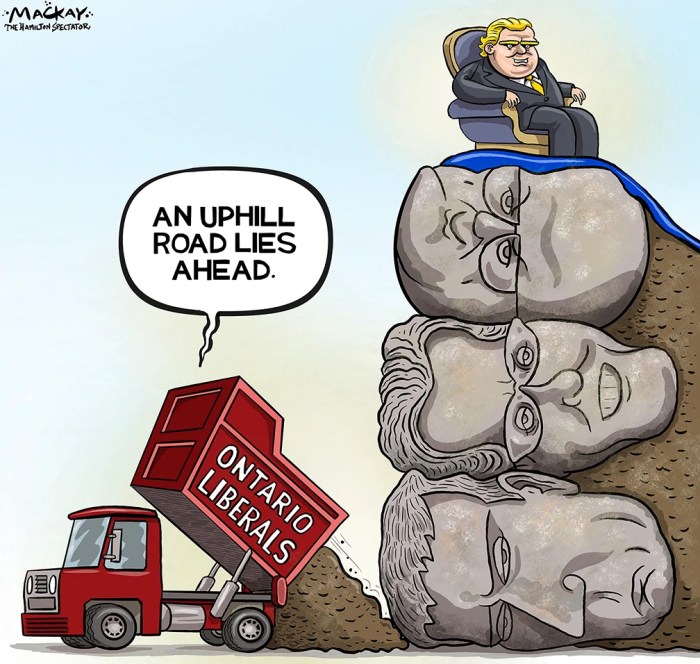
March 7, 2023 by Graeme MacKay

Editorial Cartoon by Graeme MacKay, The Hamilton Spectator – Tuesday March 7, 2023

Ontario’s Liberals hit rock bottom. Could Bonnie Crombie be their saviour?

The bad news for Ontario’s Liberals is that they’ve hit bottom.

The good news? Hitting bottom means they’ve bottomed out — and have nowhere to go but up.

Just not so fast. For a once-powerful party that has seen better days, these are early days in the rebuilding exercise.

Wait — correction: It’s not early days.

It’s been more than 1,000 days since Liberal delegates chose Steven Del Duca to begin “rebuilding” their dysfunctional dynasty at a March leadership convention precisely three years ago. Today, with only eight MPPs, Liberals are still on life support.

But after a weekend reunion in Hamilton, the party may be breathing easier. More than 1,500 diehards braved a cosmic snowstorm to preside over the rebirth of a moribund movement.

There were no formal tributes to the departed Del Duca. He is gone and now forgotten.

Instead, all eyes were on the new crop of aspiring leaders, each of them playing coy about “exploring” their candidacy and testing the waters. It doesn’t matter who they are, because you’ve likely never heard of these undeclared unknowns:

May 8, 2018

Stephanie Bowman, Ted Hsu, Yasir Naqvi, Nate Erskine-Smith and Adil Shamji. I’d tell you which ridings these backbenchers represent, federal or provincial, but if you don’t already know, it likely won’t help.

That said, I will say each of them is whip-smart: Among them — in random order — is a trade lawyer and ex-attorney general; an emergency room physician; a chartered accountant and bank vice-president; an Oxford-educated litigator; and a Princeton-educated physicist.

That’s a big brain trust, but it bears repeating — given that a physicist is among them — that political science and rocket science are unrelated. Physics requires logic, while politics demands fuzzy logic.

Which is why Premier Doug Ford’s Tories rule the province today, while the leaderless Liberals languish in obscurity and purgatory. I never make predictions, but it’s a safe bet that any of the above candidates might fail to light the party and province on fire.

Not because they’re not smart, which Del Duca was in his day. The question is whether they can touch people, reach voters, connect with them, and win them over.

May 4, 2022

None of the aspirants (two of them political rookies) strikes me as a breakout contender — at least not yet. In the old days, an unknown leader might have taken the time — and had the luxury of time — to cultivate the mass media and reap a harvest of votes at election time.

But we live in an era of celebrity politics, where a Ford can come from out of nowhere to rule Ontario and win re-election by cementing his connection to voters. Never mind the premier’s preposterous proposals to cut the gas tax, kill the carbon tax and pave a highway to nowhere — love him or hate him, people vote for him.

Against that backdrop, what’s a Liberal to do? One possibility is to fight fire with fire, meet celebrity with celebrity.

February 1, 2023

February 1, 2023

Perhaps that’s why a gaggle of former movers and retired shakers from the old Liberal brain trust took stock of the candidates and then tried to recruit the leader of another party — the Greens’ Mike Schreiner, MPP from Guelph. They published a love letter to the Delphi from Guelph that went unrequited.

For all of their flattery and folly — Schreiner is hardly brimming with crossover celebrity power — their desperate public appeal amounted to a vote of non-confidence in the current crop. Right or wrong, the mere fact that the old guard was so quick to write off the new contenders was telling.

Schreiner was a no-show on the weekend, of course. Like Del Duca, his apparition had not only come and gone but was also forgotten.

Yet that did not leave the field open to the other contenders or pretenders to the throne. Unexpectedly, they had a close encounter with celebrity power and buzz beyond the environmental movement:

October 23, 2001

Bonnie Crombie had arrived. Until recently, she had evinced no interest in the Liberal leadership, insisting her loyalty was to the mayoralty of Mississauga.

But Crombie, too, made her way through the snow drifts to the Hamilton convention centre to press the flesh — or more precisely, pose for selfies with admiring delegates in a crowded hospitality suite. Her Honour was never onstage but she stole the show.

Why now? What changed?

“She wanted to see the reaction,” an adviser said, musing that she generated “rock star status.”

Beyond celebrity power, is there a path to power? Crombie’s experience as a former MP and city councillor, now helming Canada’s sixth-biggest city, sets her apart from her rivals.

More importantly, she boasts a talent that her rivals cannot yet claim: A proven ability to poke and provoke Ford when they go face to face on the issues.

Will she run or will she walk away? Crombie is dragging her feet for now, insisting she won’t be rushed.

The only certainty is that the race is starting to get interesting. Unlike the New Democrats, who missed out on a leadership race when Marit Stiles ran unopposed, the Liberals may be in for a contest. (Martin Regg Cohn – The Toronto Star) 


Letter to the Editor

Letter to the Editor, The Hamilton Spectator, March 10, 2023 

Spec unfair to Liberals

I have always bragged to my friends in other communities how The Spectator was a smart local paper but something happened this weekend which made me rethink that. For those who didn’t know, the Ontario Liberal Party gathered in Hamilton for the first time in three years. Fifteen hundred people from all over the province braved a snowstorm to come here with the intent of reviving the party through constitutional change and electing a new executive council. There were great ideas shared and a feeling of empowerment. Coincidentally or not, federal Conservative leader Pierre Poilievre chose Saturday to have a rally in Stoney Creek. Those at the conference were aware he was in town for a couple of hours. I figured neither of the events would get a lot of coverage since we are well aware of cutbacks to newspapers, so you can imagine my surprise when I opened Monday’s paper to find a Spec reporter and photographer attended the Conservative event and not once in three days showed their face at the Liberal convention.

This is not sour grapes. This is about fair coverage especially when we have a high profile by-election. If Tuesday’s editorial cartoon is any indication, the Spec has chosen its political stance.

Sue Prestedge, Hamilton


Posted in: Ontario Tagged: Dalton McGuinty, Doug Ford, dump truck, Kathleen Wynne, leadership, letter, Liberal, Ontario, party, Steven Del Duca

Saturday March 4, 2023

March 4, 2023 by Graeme MacKay

Editorial Cartoon by Graeme MacKay, The Hamilton Spectator – Saturday March 4, 2023

Interest rates have skyrocketed. So why hasn’t the rate on your savings account budged?

As anyone with a mortgage can attest, the cost to borrow money has gotten a lot more expensive this year. Banks were swift to pass on the rate hikes the Bank of Canada implemented as part of its aggressive campaign to tame inflation.

May 2, 2020

Variable rate home loans routinely top five per cent right now, more than twice what they were a year ago.

But the same can’t be said of savings accounts, which are not paying out much more today than they were a year ago, when the Bank of Canada’s lending rate was 0.25 per cent — its lowest level on record.

Canada’s five biggest banks offer a basic savings account with a rate paying between 0.01 and 0.035 per cent at the moment. So, if you are saving $1,000 for a year, you could earn a grand total of 10 to 35 cents in interest.

Even their so-called high-interest savings accounts that come with minimum balances and other stipulations all pay less than two per cent on an annualized basis.

CBC News reached out to Royal Bank, TD Bank, CIBC, Scotiabank and the Bank of Montreal this week, asking for an explanation as to why savings account rates seem to be slow to rise while lending rates do not, and all the responses were versions of a similar theme: that their rates are based on a variety of funding costs, and while rates on savings accounts are competitive, customers can often get higher rates with products such as GICs that lock in their money for a longer term.

May 13, 2010

Natasha Macmillan, director of everyday banking with rate comparison website Ratehub.ca, says consumers are keenly aware of that gap between what’s happening to the rates on what they owe versus what they have to save.

“As soon as the Bank of Canada raises their interest rate, we see that being translated immediately on the borrowing side,” she told CBC News in an interview. “But it does take a little bit slower for it to be translated to the high-interest saving side — not quite as quickly [and] not quite at the same rate.”

Natasha Macmillan, director of everyday banking with rate comparison website Ratehub.ca, says consumers are keenly aware of that gap between what’s happening to the rates on what they owe versus what they have to save.

“As soon as the Bank of Canada raises their interest rate, we see that being translated immediately on the borrowing side,” she told CBC News in an interview. “But it does take a little bit slower for it to be translated to the high-interest saving side — not quite as quickly [and] not quite at the same rate.” 

That’s not happening today, and there are a few reasons why… (Continued: CBC) 


Posted in: Business, Canada, International Tagged: 2023-05, accounts, banker, banks, Canada, customer service, Fast food, interest rate, money, savings, senior

Friday March 3, 2023

March 3, 2023 by Graeme MacKay

Editorial Cartoon by Graeme MacKay, The Hamilton Spectator – Friday March 3, 2023

Did foreigners interfere in Canada’s elections? Don’t expect politicians to sort it out

The best argument so far for an independent inquiry into foreign election interference in Canada has come from the least independent voices in this escalating furor — politicians and members of Parliament.

February 25, 2023

A hearing at a Commons committee on Wednesday vividly proved the point. National security discussions should come with a warning label — don’t try this at home. Or more accurately, don’t try this in the House.

It comes down simply to this: the question of whether foreign actors have been meddling in Canadian elections is simply too important to be litigated by the people who were players in those elections, with vested interests. That goes for all the political parties: the governing Liberals and their opposition rivals.

Opposition parties are in fact on side with the idea of some independent inquiry, though Conservative leader Pierre Poilievre also wants MPs to continue their Commons committee investigation, such as it is right now.

“We cannot allow this affair to simply go up in smoke with a secret private investigation, it must be public so that Canadians know exactly what is going on,” Poilievre told reporters on Wednesday. “We cannot shut those parliamentary inquiries down with a promise that in two years there will be some report on a public inquiry.”

But if Wednesday’s Commons hearings were any indication, Canadians aren’t going to get many answers from the political arena. Justin Trudeau’s national security adviser, Jody Thomas, explained as much during her testimony.

January 16, 2020

“We cannot talk about national security information in a public forum,” said Jody Thomas, who stared down this committee with the same, flat, no-nonsense tone she brought to last fall’s public inquiry into the “freedom convoy.” Thomas said at those hearings that she was one of the influential advisers saying yes to a declaration of emergency on the convoy last winter. On Wednesday, she made clear she’s one of the people on the inside arguing against a wide-open public inquiry.

A lot of the back and forth between MPs, Thomas and other senior security officials testifying on Wednesday proved the national security adviser’s point. MPs — who do come from political parties — were gamely trying to get the security people to say how much political parties were in the loop about possible election threats in 2019 and 2022.

Sorry, the politicians were told — that’s top secret. (Though the officials did manage to reveal that the RCMP is not investigating any of the allegations surfacing in the media of late, which is significant.)

The problem with politicians looking into political interference is that they’re not the ones who need to be reassured that Canadian elections are free and fair. It’s the voting public, and the news on that right now is not good.

November 24, 2020

An Angus Reid poll released this week showed that a disturbing two-thirds of Canadians believed that China either definitely or probably tried to influence the past two elections in Canada. An even more disturbing 42 per cent of past Conservative voters were inclined to believe the elections had been “stolen.” Sound familiar?

That means that the horse is already out of the barn on this one. Reassurances from the Liberal government will just feed the cynicism of non-Liberal voters, while opposition’s continuing attempts to cry foul could make those parties sound like they have an axe to grind — a pox on all their houses, in other words.

The opposition leaders are right to ask that their parties have a voice in determining the shape of any future inquiry. In the past, I’ve been told, no election-reform legislation proceeded without broad agreement between all the parties.

That may have been a myth, I haven’t tested that against the long historical record. But it seems the point is wise. On something as important as democracy and electoral legitimacy, you don’t want anyone saying that the ruling party put its thumb on the scale.

Trudeau continues to say that we have all the inquiries we need into electoral interference right now and they need to run their course. The current Commons committee hearings, with no offence to any of the MPs doing their questioning, is not going to be the final word — any more than the various parliamentary hearings into the convoy, which paled in comparison to Justice Paul Rouleau’s inquiry.

Trudeau’s next move should be to convene a meeting of all the opposition leaders, swear them to the highest levels of security clearance, and hammer out how they can get a grasp on this issue before the public gets any more cynical about the fairness of elections. That one gesture in itself would prove that the politicians are putting democracy over their partisan interests.

It would also, as a bonus, be enormously frustrating to whatever foreign actors are enjoying the current spectacle of Canadians questioning whether their democracy works. (The Toronto Star)


Posted in: Canada Tagged: 2023-04, Canada, China, Democracy, election, interference, Justin Trudeau, Pierre Poilievre, Printed in the Toronto Star, Punch and Judy, puppet, Xi Jinping

Friday March 3, 2023

March 3, 2023 by Graeme MacKay

Editorial Cartoon by Graeme MacKay, The Hamilton Spectator – Friday March 3, 2023

Bused out of Quebec, francophone asylum seekers struggle to get medical services

Over the phone, the woman’s voice is regretful but hurried — she says she’s sorry, but if the French-speaking migrant on the other end of the line cannot find someone to translate English, the doctor won’t see him for the medical exam he needs in order to claim asylum in Canada.

March 24, 2022

CBC News obtained a recording of the phone conversation the man says took place Wednesday in Niagara Falls, Ont. 

“It’s not possible to speak with the doctor if you can’t speak English,” the woman tells him in French. “You have to find someone at your hotel to help you.” 

“I don’t know anyone here,” Guirlin — whose last name CBC News has agreed to withhold because of his precarious immigration status — replies.

Guirlin and his family are among the more than 5,500 asylum seekers who have been bused by Canada’s government from Quebec’s border with the U.S. to cities in Ontario, including Windsor, Cornwall and Niagara Falls. 

They are also among a number of those — mostly francophones from Haiti or countries in Africa — for whom the transfer happened against their wishes since they could not afford to find a place to stay immediately. Their plan all along was to live in Quebec.

February 17, 2023

Guirlin, his wife, who is six months pregnant, and their four-year-old son ended up in Niagara Falls on Feb. 14. Originally from Haiti, the family had been struggling to make ends meet in Brazil, when they decided to travel north through a dozen countries to make their way to Canada. 

When they arrived on Feb. 11 via Roxham Road, the popular irregular border crossing south of Montreal, they were asked by immigration officers where they planned to live in Canada.

“I said we want to stay in Montreal because I don’t speak English and my wife doesn’t either, and she needs to have medical appointments for the pregnancy,” Guirlin said in a phone interview Thursday. 

He says they were told in the following days there was no space for them in Montreal, and that they were being sent to Ontario. They boarded a bus with roughly 40 other asylum seekers from a number of other countries last Tuesday. For now, the government has put them up in a hotel. (CBC) 


Posted in: Canada, International, Quebec, USA Tagged: 2023-04, Asylum seekers, Border, Canada, Francois Legault, french, Haiti, Immigration, Justin Trudeau, language, migrant, Niagara Falls, Quebec, refugee, Roxham Road

Thursday March 2, 2023

March 2, 2023 by Graeme MacKay

Editorial Cartoon by Graeme MacKay, The Hamilton Spectator – Thursday March 2, 2023

Google is stealing from Canadian newspapers and advertisers

June 26, 2019

For 15 years, we’ve all been hearing a fake story about why newspapers around the world are dying. It goes like this — the internet killed the news, with old, slothful media companies being unwilling to adapt to new technology. The closer you look, the less sense this story makes. There are plenty of new media companies, everyone from the Huffington Post to BuzzFeed, digitally native firms with deep pockets and clever managers, who can generate huge amounts of web traffic, but aren’t able to sell the advertising to monetize it. And there is still advertising, lots of it. It’s just that the money for those ads isn’t going to the newspapers on whose sites they sit.

The real story of why newspapers are suffering can be found in an action in January by U.S. Attorney General Merrick Garland, when the U.S. Justice Department’s Antitrust Division, along with eight U.S. states, filed a suit to break up Google’s advertising business. According to American enforcers, the search giant has unlawfully engaged in “monopolizing multiple digital advertising technology products,” basically the software plumbing underneath most online advertising, and thus, the revenue that newspapers rely on. Google inflated its profits, redirecting advertising revenues from newspapers to itself.

June 12, 2019

It’s a complex story, but at the heart of it is what looks like theft. Most of us think of Google as a search engine, and it is. But Google has many other lines of business. This particular suit involves display ads on the open web, which are what you find on the Wall Street Journal or ESPN. These ads are bought and sold in an unusual manner. If a user goes to the site of a newspaper, unbeknownst to the consumer, a highly complex financial market kicks into gear. Newspapers no longer sell most of their advertising directly but have become integrated into a giant set of global auctions. In these auctions, advertisers bid for the right to place their ad not into a specific newspaper, but in front of a specific user. Money then changes hands, from the buyer of the ad to the publisher, with a set of middlemen each taking a cut. This happens in a split second, billions of times a day. At this point, online advertising is far bigger than the stock market in terms of the number of transactions.

Well, guess who runs the software to manage this financial market? Google. And guess who takes the lion’s share of the revenue? Google.

March 21, 2018

There’s a decade-plus-long backstory to this scheme. In the mid-2000s, Google transitioned from its role as a search engine into the main intermediary of all online advertising. In 2005, Google had a lot of advertisers that were buying its search ads. It also started to let smaller websites put strips of ads up and gave them a share of the revenue. Ad industry insiders at the time realized that advertising was transitioning from a Mad Men-style set of local, regional and national markets to an automated set of marketplaces.

Google’s strategy wasn’t to remain a search engine, but to expand and control all online advertising. But the firm had a problem. It couldn’t break into the market for the space on big established publisher sites, because that market was already controlled by another near-monopolist, DoubleClick. DoubleClick had 60 per cent market share in the software used by publishers to manage how they sell ads on their site, or what’s known as an ad server. So, Google’s then-CEO, Eric Schmidt, did what every good monopolist does when in a lax policy regime: he bought his rival — DoubleClick — in 2007. (Continued: The National Post) 


Posted in: Canada, International Tagged: 2023-04, Canada, google, media, news, newspapers, print media, search engine
« Previous 1 … 3 4 5 Next »
...Check it out and please subscribe!

Your one-stop-MacKay-shop…

T-shirts, hoodies, clocks, duvet covers, mugs, stickers, notebooks, smart phone cases and scarfs

2023 Coronation Design
Follow Graeme's board My Own Cartoon Favourites on Pinterest.

MacKay’s Virtual Gallery

Copyright © 2016 mackaycartoons.net

Powered by Wordpess and Alpha.

DMCA.com Protection Status
Loading Comments...
