MacKay - Canadian Editorial Cartoons
mackaycartoons

Graeme MacKay's Editorial Cartoon Archive

  • Who?
  • Copyright
  • Boutique
  • Kings & Queens
  • Prime Ministers
  • Presidents
  • The French Monarchy Project
  • DOWNLOADS

United Nations

Friday November 12, 2021

November 12, 2021 by Graeme MacKay

Editorial Cartoon by Graeme MacKay, The Hamilton Spectator – Friday November 12, 2021

Yes, Doug Ford’s government has a ‘cohesive plan.’ No, it’s not for the environment, critics say

Critics of the Ford government’s environment plan say a recent pledge to build highways in Ontario is the latest in a series of moves that signals it does not have a real plan to tackle climate change. 

November 13, 2020

“We’re losing ground,” said Laura Bowman, staff lawyer with the environmental law firm Ecojustice. 

Bowman said Premier Doug Ford’s government is making development a priority with its promise last week to build Highway 413 and the Bradford Bypass, two controversial highways in the Greater Toronto Area. Critics say they’ll add more vehicles to the roads when they’re completed, which will pump more greenhouse gases into the atmosphere and make it much more difficult to meet the province’s emissions targets.

The Progressive Conservative government counters by saying the new highways will help lessen gridlock and cut commute times, thereby cutting emissions from idling vehicles stuck for hours in traffic. But environmentalists don’t buy that argument and say the PCs do not have a history of taking the climate crisis seriously.

“The current government’s track record has been one of rapidly dismantling environmental protection,” Bowman told CBC Toronto Friday.

October 16, 2020

Since taking power, the PCs have made several changes to environmental policies, including the Endangered Species Act, scrapping carbon pricing and electric vehicle rebates. 

But the government has also repeatedly said it is tackling the climate crisis. Environment Minister David Piccini is attending the UN Climate Change Conference (COP26) in Glasgow, Scotland. His office said he is there to “build international partnerships for Ontario’s clean industry, explore emerging best practices, and contribute the province’s voice to the global conversation.”

When questioned about why its fall economic statement last week just mentioned climate change only twice, Finance Minister Peter Bethlenfalvy pointed out his government is investing $295 million to upgrade Ford’s Oakville assembly plant to make electric vehicles, matching the federal government’s contribution.

“That’s going to reduce emissions,” he said. 

He also pointed to his government’s investments in expansive transit projects, namely in the Greater Toronto and Hamilton Area. The province is budgeting $61.6 billion for transit over the next decade, three times more than the $22.9 billion allotted for highways. (CBC) 


Posted in: Ontario Tagged: 2021-38, climate change, COP26, Doug Ford, environment, International, laggard, Ontario, snail, United Nations, world

Saturday October 30, 2021

November 1, 2021 by Graeme MacKay

Editorial Cartoon by Graeme MacKay, The Hamilton Spectator – Saturday October 30, 2021

COP26 climate talks off to an ominous start after weak G20 leaders’ meeting

It was in the city of Glasgow that Scottish engineer James Watt improved the workings of the steam engine and, unwittingly, kicked off the Industrial Revolution. Never could he have imagined that humans would burn so much coal, oil and gas over the next two centuries that they would imperil the very climate that has allowed for their existence.

June 6, 2007

More than 120 leaders will speak Monday in the very same city to begin the COP26 climate talks, where they will set the tone for two weeks of negotiations that can either end with a plan to rapidly decarbonize the planet, or make watery statements to delay what the science shows is needed, possibly pushing it off until it’s too late. Climate leaders and experts are calling it the world’s last best chance to address the climate crisis.

UK Prime Minister Boris Johnson, whose government is hosting the talks, will warn Monday that humanity has run down the clock on climate change.

“It’s one minute to midnight, and we need to act now,” he will say in an opening speech, according to remarks sent to journalists.

“We have to move from talk and debate and discussion to concerted, real-world action on coal, cars, cash and trees. Not more hopes and targets and aspirations, valuable though they are, but clear commitments and concrete timetables for change.”

The G20 leaders’ meeting that ended in Rome on Sunday suggests that leaders are finally listening to the science, but they still lack the political unity to make the ambitious decisions required to meet the moment.

August 13, 2021

The latest UN climate science report published in August made clear what needs to happen — deep, sustained cuts to greenhouse gas emissions over this decade to have any chance of limiting global warming to 1.5 degrees above levels before industrialization. Even with all the newly announced pledges, the world is still on track for 2.7 degrees of heating.

Global warming beyond 1.5 degrees will bring worsening impacts of the climate crisis. But the positive news is that the 1.5 limit is entirely in our reach. The UN report showed that by mid-century, the world needs to reach net zero — where greenhouse gas emissions are no greater than the amount removed from the atmosphere — and warming can be stopped in its tracks.

All of this scientific language was in the G20 leaders’ communiqué, including an acknowledgment that to meet net zero by mid-century, many member nations will need to lift their emissions-reductions pledges, known as Nationally Determined Contributions (NDCs), over this decade. (CNN) 


Posted in: Canada, International, USA Tagged: 2021-36, Canada, climate change, COP 26, Emmanuel Macron, France, green room, Grim reaper, Joe Biden, Justin Trudeau, Prince Charles, speech, UK, United Nations, USA

Wednesday March 4, 2020

March 11, 2020 by Graeme MacKay

Editorial Cartoon by Graeme MacKay, The Hamilton Spectator – Wednesday March 4, 2020

Ex-PM Joe Clark campaigns for Security Council seat in Africa, Persian Gulf

Former prime minister and foreign minister Joe Clark faces a tough slog during his travels to the Persian Gulf and Africa to campaign for Canada’s bid for the United Nations Security Council, analysts said Monday.

Joe Clark

Clark began a one-week trip Monday as “special envoy” to Algeria, Bahrain, Qatar and Egypt to campaign for Canada’s bid for a temporary two-year seat on the UN’s most powerful body.

If elected, the Trudeau government says Canada will continue to work to strengthen multilateralism, foster peace, address climate change, promote economic security and advance gender equality.

Bessma Momani, an expert in Middle East affairs at the University of Waterloo, says Clark may not get a very receptive audience to Canada’s push for women’s rights among some of the government representatives he will be meeting.

“The people certainly hold Canada in high regard, regardless of what the governments may think,” Momani said. “People are still queuing to immigrate here so clearly we are still doing something right.”

“Certainly our recent emphasis on human rights and women’s rights is probably not received that favourably in that part of the world, which tends to have more conservative values and are part of the global autocratic turn.”

February 8, 2020

Prime Minister Justin Trudeau visited Ethiopia and Senegal in February as part of his government’s campaign for the council seat. Several cabinet ministers have also been visiting countries across Africa in recent months.

The secret ballot at the UN General Assembly takes place in June for a two-year term starting next year.

Africa, with its 54 voting countries, is a key voting bloc in the tough fight that pits Canada against Norway and Ireland for two available seats. Both countries spend more per capita than Canada on foreign aid, which is seen by many analysts as an impediment to Canada’s chances to winning the competition.

December 10, 2003

Clark is an appropriate choice to campaign in the region, but he will have his work cut out for him, said Fen Hampson, a Carleton University expert who wrote a recent book on the foreign policy of the ex-prime minister Brian Mulroney. Clark served as Mulroney’s minister of external affairs.

“African leaders with long memories will recall the important role Joe Clark and Brian Mulroney played in the Commonwealth in helping to bring an end to apartheid in South Africa and also stepping up to the plate in the Ethiopian famine crisis,” said Hampson. (CTV News) 


Posted in: Canada Tagged: 2020-08, Canada, diplomacy, Joe Clark, Justin Trudeau, Maple Leaf, Mascot, security council, seminar, U.N., U.N. Security Council, United Nations

Saturday February 8, 2020

February 15, 2020 by Graeme MacKay

Editorial Cartoon by Graeme MacKay, The Hamilton Spectator – Saturday February 8, 2020

As Trudeau campaigns in Africa for UN Security Council seat, Norwegian PM is steps behind

Nearly everywhere Justin Trudeau goes in Addis Ababa, it seems Norway’s prime minister isn’t far behind.

September 21, 2016

On Saturday, Norwegian Prime Minister Erna Solberg arrived to an African Union meeting on gender equality just minutes after Trudeau did. Then, she followed in Trudeau’s footsteps, strolling through Unity Park with the Ethiopian prime minister. And as Trudeau was leaving Jubilee Palace from his meeting with the Ethiopian president, Solberg’s staffers were in the building preparing for her imminent arrival.

It’s no coincidence. The two leaders are both in Africa to win support from world leaders for a UN Security Council seat they both want to win. And Norway’s prime minister is suggesting that when it comes to that campaign, it may be Canada who is trailing behind.

“I think one of the differences, of course, is we have been on the steady same path for a very long time, so [African leaders] know us,” Solberg told Canadian reporters.

Take, for example, the African Union meeting. Trudeau made history on this trip by being the first Canadian prime minister to attend an African Union session. But Solberg was also here last year.

January 13, 2018

The African Union is a rich source of potential votes for any country looking to win a Security Council seat. It has 54 voting members at the United Nations, roughly a quarter of the total votes.

Speaking to Canadian reporters, the Norwegian leader said she didn’t want to emphasize competition between the two countries, noting they take the same approach to many issues. But she suggested Norway was perhaps more deeply engaged.

“Canada is a bigger economy, a larger country, of course, but on the other hand we are using more in development aid. We have used more support for the international policies as part of our GDP.”

In 2018, Norway spent nearly one per cent of its gross national income on international assistance. For Canada, the figure was 0.28 per cent, according to OECD figures.

October 13, 2010

Norway, Ireland and Canada are all gunning for one of the two limited-term UN Security Council seats that open up next year.

Ireland too, has been plotting a course of engagement with Africa for years. It launched its “Africa Strategy” in 2011.

While all countries see the seat as something of a prize that would allow their countries to play an influential role in world affairs, Solberg said the seat is also something of a burden.

“It’s an obligation that you have as supporters of multi-lateralism, as a supporter of rule of law. “

“You have to take the burden of sitting on the Security Council, because it’s also a burden. You have to take a stand on some policy decisions that as a non-member you don’t have to do.” (CBC) 


Posted in: Canada Tagged: 2020-05, Africa, Canada, charm, diplomacy, flowers, foreign affairs, Ireland, Norway, security council, U.N. Security Council, UN, United Nations

Saturday August 10, 2019

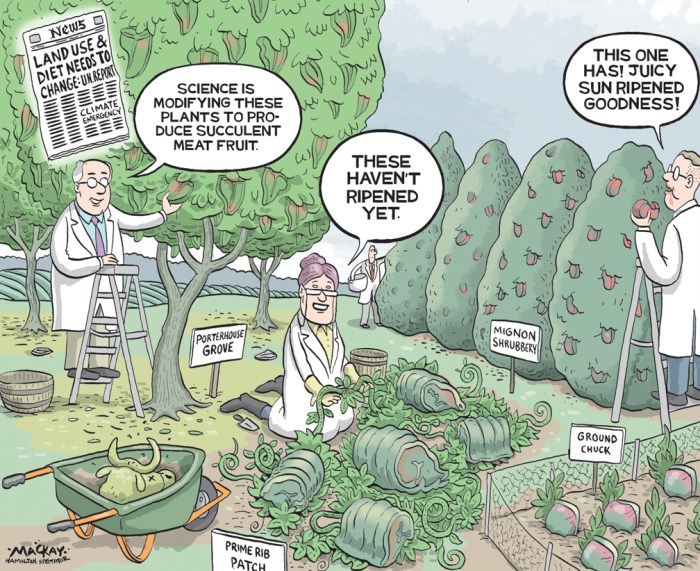
August 17, 2019 by Graeme MacKay

Editorial Cartoon by Graeme MacKay, The Hamilton Spectator – Saturday August 10, 2019

To reduce global warming, people need to eat less meat: UN report

Global meat consumption must fall to curb global warming, reduce growing strains on land and water and improve food security, health and biodiversity, a United Nations report on the effects of climate change concluded.

Although the report stopped short of explicitly advocating going meat free, it called for big changes to farming and eating habits to limit the impact of population growth and changing consumption patterns on stretched land and water resources.

Plant-based foods and sustainable animal-sourced food could free up several million square kilometres of land by 2050 and cut 0.7-8.0 gigatonnes a year of carbon dioxide equivalent, the U.N.’s Intergovernmental Panel on Climate Change (IPCC) said.

“There are certain kinds of diets that have a lower carbon footprint and put less pressure on land,” Jim Skea, professor at London’s Imperial College, said on Thursday.

The IPCC met this week in Geneva, Switzerland to finalize its report which should help to guide governments meeting this year in Chile on ways to implement the 2015 Paris Agreement.

“The IPCC does not recommend people’s diets … Dietary choices are very often shaped or influenced by local production practices and cultural habits,” Skea, who is one of the report’s authors, told reporters in Geneva. (National Post) 


Posted in: Canada, International Tagged: 2019-28, Agriculture, beef, climate change, farming, food, genetically modified, International, meat, Science, ScienceExpo, U.N., United Nations
« Previous 1 2 3 4 … 6 Next »
...Check it out and please subscribe!

Your one-stop-MacKay-shop…

T-shirts, hoodies, clocks, duvet covers, mugs, stickers, notebooks, smart phone cases and scarfs

2023 Coronation Design
Follow Graeme's board My Own Cartoon Favourites on Pinterest.

MacKay’s Virtual Gallery

Copyright © 2016 mackaycartoons.net

Powered by Wordpess and Alpha.

DMCA.com Protection Status
Loading Comments...