MacKay - Canadian Editorial Cartoons
mackaycartoons

Graeme MacKay's Editorial Cartoon Archive

  • Who?
  • Copyright
  • Boutique
  • Kings & Queens
  • Prime Ministers
  • Presidents
  • The French Monarchy Project
  • DOWNLOADS

cost of living

Tuesday June 22, 2021

June 29, 2021 by Graeme MacKay

Editorial Cartoon by Graeme MacKay, The Hamilton Spectator – Tuesday June 22, 2021

After a year of pandemic prudence, Canadians likely eager to spend the billions saved

If there is one silver lining to the COVID-19 pandemic for Grayham Havens, it was celebrating his two-year anniversary with his wife by purchasing a house last month.

January 18, 2018

All the government restrictions during the pandemic helped him drastically reduce his spending over the last year and begin socking away cash every month. After clearing leftover debt, the couple saved enough for a down payment.

Now, at the age of 40, Havens is a first-time home owner.

“We’re so fortunate, very fortunate, to get something like this,” he said about their grey bungalow in southeast Calgary, complete with a large deck, fire pit and pond in the backyard.

Havens isn’t alone. Canadians have saved a record amount of money during the pandemic, resulting from the combined impact of reduced spending and collecting more money from government support programs.

Havens and his wife were both able to collect Alberta’s critical worker benefit, as he was working in the grocery sector and she was involved in health care.

At the same time, their discretionary expenses — spending at places like restaurants and movie theatres — dropped sharply.

“We started saving thousands every month,” he said. “It started making me realize just how bad we were budgeting our own money in the first place. I mean, money was leaking left and right.”

Not everyone has extra money in the bank — but many do.

In fact, Canadians amassed $212 billion last year, versus $18 billion in 2019, according to Statistics Canada. That works out to $5,574 per Canadian on average in 2020, compared to $479 in the previous year.

The average savings rate jumped from 1.3 per cent of disposable income in 2019, to 14.9 per cent in 2020. In April, May and June of 2020, the savings rate peaked at about 27 per cent.

As a result, credit card balances are down, fewer people are behind on payments and credit scores are up, according to credit rating agency Equifax Canada.

The situation varies greatly from household to household, as there continues to be a deep division between the financial situation of many Canadians. In short, if you were able to keep your job and stay healthy, you were likely to see your finances improve during the pandemic.

“It was easy to save. It was not very forced. I can’t go get my nails done, get my hair done, going to the pubs a lot less,” said Karen Jacobs, who also purchased her first house, with her husband, in February.

They are now renovating the home from top to bottom after saving nearly $1,000 a month during the pandemic, including through lower phone and insurance bills.

The record level of savings is not the only reason behind Canada’s rising home prices, but it could provide a significant level of economic stimulus across the country. (CBC) 
 

Posted in: Canada Tagged: 2021-22, Canada, cost of living, covid-19, inflation, pandemic, Pandemic Times, piggy bank, price hikes, savings, taxes, Wheel of Fortune

Thursday December 6, 2018

December 13, 2018 by Graeme MacKay

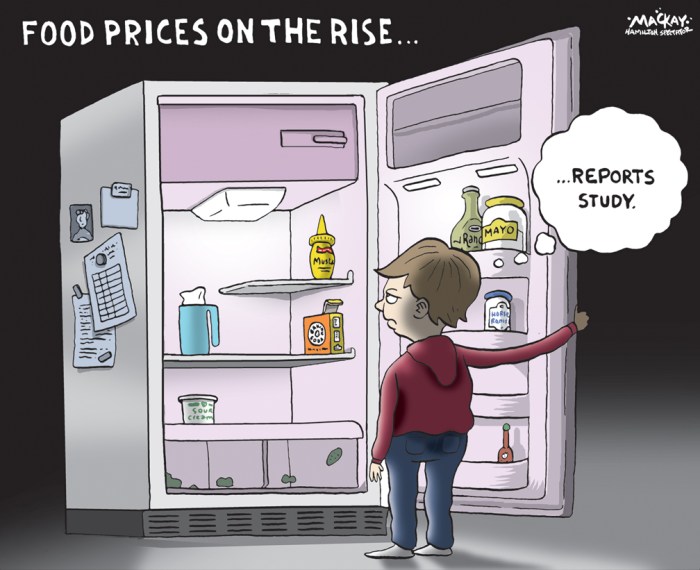
Editorial Cartoon by Graeme MacKay, The Hamilton Spectator – Thursday December 6, 2018

Food price report predicts average family to pay $400 more for groceries next year

The average Canadian family will pay about $400 more for groceries and roughly $150 more for dining out next year, an annual food price report predicts.

December 8, 2016

Food prices will rise between 1.5 to 3.5 per cent in 2019, according to the report from researchers at the University of Guelph and Dalhousie University. That means the average family of four will spend $12,157 next year — up $411 from 2018.

Vegetables will see the biggest price jumps — between four and six per cent for the category, according to the report.

Meanwhile, meat and seafood prices are expected to fall, with the meat category to decline by one to three per cent and seafood costs to remain the same or fall up to two per cent.

Since 2015, the team has predicted prices in those two categories would rise as high as six per cent each year.

“This is a bit of a risk for us … We’ve never done that,” said Sylvain Charlebois, one of the lead researchers and a professor at Dalhousie University, referring to anticipating a decline.

But the team is confident in its prediction.

April 25, 2014

They believe there’s an oversupply of meat, he said, and Canadians are eating less animal protein. Instead, they’re showing more interest in alternative proteins, like quinoa and lentils.

The plant-based protein trend is evident in recent manufacturer and restaurant moves as well.

Meat processors Maple Leaf Foods Inc., for example, acquired two companies in this niche in recent years, Lightlife Foods and Field Roast GrainMeat Co. 

At the same time, fast food chains have started adding vegan and vegetarian options to their menus. A&W Food Services of Canada Inc. even temporarily sold out of its Beyond Meat patties shortly after adding them to its menu.

Industry watchers have attributed the demand for plant-based protein to millennials, health-conscious baby boomers and concerns around antibiotic use in agriculture.

December 23, 2004

A turning point for animal protein, though, was 2014 when beef prices started to rise dramatically, said Charlebois.

Between December 2013 and December 2014 the monthly average retail price for one kilogram of ground beef rose more than 26 per cent, according to Statistics Canada data. For comparison, the price advanced about 3.5 per cent from December 2012-13. It reached a record high of $13.23 in October 2015.

“It really spooked consumers,” said Charlebois, adding they started substituting plant-based protein into their diet.

Butchers and grocers will likely take it easy on beef prices next year in an effort to bring people back to the red meat, he said. (Source: Hamilton Spectator) 


Posted in: Canada Tagged: condiments, cost of living, food, nutrition, Poverty, prices, refrigerator

Thursday December 8, 2016

December 7, 2016 by Graeme MacKay

Editorial Cartoon by Graeme MacKay, The Hamilton Spectator Ð Thursday December 8, 2016 Families could pay up to $420 more for food in 2017, report finds The average Canadian family may need to dish out as much as $420 more for food next year Ñ and consumers could have president-elect Donald Trump to thank for part of the price bump, the lead author of a new report says. Canada's Food Price Report, published by researchers at Dalhousie University in Halifax, was released Monday evening. The annual report, which looks ahead to 2017, cites weather disruptions caused by La Nina, energy-related costs Ñ including the potential effect of carbon pricing on the agricultural sector Ñ and a weak Canadian dollar as factors in the expected price hikes. Economists forecast the loonieÊcould fall as low as 70 cents US in 2017, and a weaker dollar would reduce the buying power of importers. "Everything we actually import from everywhere will increase in price," says Sylvain Charlebois, lead author of the report. But Charlebois, who works with the faculties of management and agriculture at Dalhousie, suggests there's one more major factor that could contribute to the increase in food prices: the incoming U.S. President. "We are expecting Canadian shoppers to be Trumped at the grocery store," said Sylvain Charlebois, lead author of the report. The annual report, which has come from the University of Guelph in years past, says the "proverbial sweet spot for food inflation" is between one and two per cent each year.ÊÊAt that rate, the increases are manageable for restaurateurs, grocery stores and consumers, the authors say. The latest report looks forward to 2017 and finds that food prices could increase between three per cent and five per cent Ñ with meat, vegetables, fish and other seafood projected to jump by as much as four to six per cent. Regionally, Ontario and British Columbia are expected to see most of the increases. (Source: CBC)Êhttp://www.cbc.ca/news/business/food

Editorial Cartoon by Graeme MacKay, The Hamilton Spectator – Thursday December 8, 2016

Families could pay up to $420 more for food in 2017, report finds

The average Canadian family may need to dish out as much as $420 more for food next year — and consumers could have president-elect Donald Trump to thank for part of the price bump, the lead author of a new report says.

December 11, 2015

Canada’s Food Price Report, published by researchers at Dalhousie University in Halifax, was released Monday evening.

The annual report, which looks ahead to 2017, cites weather disruptions caused by La Nina, energy-related costs — including the potential effect of carbon pricing on the agricultural sector — and a weak Canadian dollar as factors in the expected price hikes.

Economists forecast the loonie could fall as low as 70 cents US in 2017, and a weaker dollar would reduce the buying power of importers.

Friday April 25, 2014“Everything we actually import from everywhere will increase in price,” says Sylvain Charlebois, lead author of the report.

But Charlebois, who works with the faculties of management and agriculture at Dalhousie, suggests there’s one more major factor that could contribute to the increase in food prices: the incoming U.S. President.

“We are expecting Canadian shoppers to be Trumped at the grocery store,” said Sylvain Charlebois, lead author of the report.


Editorial Cartoon by Graeme MacKay, The Hamilton Spectator Ð Wednesday April 6, 2016 Panama Papers: Document leak exposes global corruption, secrets of the rich The financial secrets of heads of state, athletes, billionaires and drug lords have been exposed in the latest Ñ and biggest ever Ñ leak of records from an offshore tax haven. The leak includes 11.5 million confidential documents shedding light on the assets and murky fiscal dealings of everyone from the prime ministers of Iceland and Pakistan to soccer player Leo Messi, movie star Jackie Chan and associates of Russian President Vladimir Putin. The records, dating as far back as 1977, come from a little-known but highly influential Panama-based law firm called Mossack Fonseca, which has 500 staff working in 40-plus countries. The firm is one of the world's top creators of shell companies Ñ corporate structures that can be used to hide ownership of assets. German newspaper SŸddeutsche Zeitung obtained the files from a source and shared them with global media partners, including CBC News and the Toronto Star, through the Washington-based International Consortium of Investigative Journalists. CBC News will be exploring more of what's in the documents, including Canadian connections, in a series of stories this week. "These findings show how deeply ingrained harmful practices and criminality are in the offshore world," said Gabriel Zucman, an economist at the University of California at Berkeley and author of The Hidden Wealth of Nations: The Scourge of Tax Havens. Zucman, who was briefed on the media partners' investigation, said the release of the leaked documents should prompt governments to seek "concrete sanctions" against jurisdictions and institutions that peddle offshore secrecy. While offshore accounts are not in themselves illegal, the leaked records show they are often used to shield illicit dealings. In a written response to questions from the media consortium, Mossack Fonseca said it "do

April 6, 2016

The annual report, which has come from the University of Guelph in years past, says the “proverbial sweet spot for food inflation” is between one and two per cent each year.  At that rate, the increases are manageable for restaurateurs, grocery stores and consumers, the authors say.

The latest report looks forward to 2017 and finds that food prices could increase between three per cent and five per cent — with meat, vegetables, fish and other seafood projected to jump by as much as four to six per cent. Regionally, Ontario and British Columbia are expected to see most of the increases. (Source: CBC)


Posted in: Canada Tagged: banks, Canada, cost of living, Finance, food, groceries, living, loan, prices, standard

Wednesday August 17, 2016

August 16, 2016 by Graeme MacKay

Editorial Cartoon by Graeme MacKay, The Hamilton Spectator Ð Wednesday August 17, 2016 Energy minister, Wynne defend decision to put carbon tax in delivery line on bills Premier Kathleen Wynne is defending the decision to bury the cost of Ontario's cap-and-trade plan in the "delivery" line on natural gas bills. The Ontario Energy Board announced last week that costs related to the Liberals' climate change plan would not appear in a separate line item on consumers' bills for natural gas, which is used to heat most homes in the province. Wynne said Thursday that the government doesn't interfere with decisions made by an arms-length agency like the energy board, which she pointed out consulted the industry and public before issuing its directive on carbon pricing. "My understanding is they talked with local distribution companies, they talked to consumer groups across the province, and as you know, they are an independent body," she said. "They made a decision to configure the bills that way and we don't direct the OEB.Ó Quebec and British Columbia include the cost of carbon pricing as a separate line item on bills. But like Wynne, Energy Minister Glen Thibeault insisted it was the energy board's decision to put the cost of cap and trade in the delivery charge instead of its own line on bills. Thibeault insisted nothing was being hidden, and said the government was being transparent about the cost of cap-and-trade just by talking about the new fee. The minister walked away from reporters without answering when asked if the energy board now sets policy for the Liberal government. The Liberals expect their climate change plan will add about $5 a month to home heating bills and about 4.3 cents a litre to the price of gasoline. Ontario will join an existing cap-and-trade market with California and Quebec next January, mandating pollution limits on companies but allowing them to buy emission credits or sell them to others if they are under their quota. (CTV News)

Editorial Cartoon by Graeme MacKay, The Hamilton Spectator – Wednesday August 17, 2016

Energy minister, Wynne defend decision to put carbon tax in delivery line on bills

Tuesday April 14, 2015Premier Kathleen Wynne is defending the decision to bury the cost of Ontario’s cap-and-trade plan in the “delivery” line on natural gas bills.

The Ontario Energy Board announced last week that costs related to the Liberals’ climate change plan would not appear in a separate line item on consumers’ bills for natural gas, which is used to heat most homes in the province.

Wynne said Thursday that the government doesn’t interfere with decisions made by an arms-length agency like the energy board, which she pointed out consulted the industry and public before issuing its directive on carbon pricing.

April 19, 2016

April 19, 2016

“My understanding is they talked with local distribution companies, they talked to consumer groups across the province, and as you know, they are an independent body,” she said. “They made a decision to configure the bills that way and we don’t direct the OEB.”

Quebec and British Columbia include the cost of carbon pricing as a separate line item on bills.

But like Wynne, Energy Minister Glen Thibeault insisted it was the energy board’s decision to put the cost of cap and trade in the delivery charge instead of its own line on bills.

Wednesday April 15, 2015Thibeault insisted nothing was being hidden, and said the government was being transparent about the cost of cap-and-trade just by talking about the new fee.

The minister walked away from reporters without answering when asked if the energy board now sets policy for the Liberal government.

The Liberals expect their climate change plan will add about $5 a month to home heating bills and about 4.3 cents a litre to the price of gasoline.

Ontario will join an existing cap-and-trade market with California and Quebec next January, mandating pollution limits on companies but allowing them to buy emission credits or sell them to others if they are under their quota. (Source: CTV News)


Posted in: Ontario Tagged: cap and trade, carbon tax, climate change, cost of living, easter bunny, environment, Kathleen Wynne, Ontario, Peter Cottontail, rate payers

Friday April 25, 2014

April 25, 2014 by Graeme MacKay

Friday April 25, 2014

By Graeme MacKay, The Hamilton Spectator – Friday April 25, 2014

Canada passes US in middle-class wealth

According to a New York Times report, the rich in the US are getting richer, but the poor and middle classes are falling behind some of their Western peers.

“Middle-class incomes in Canada – substantially behind in 2000 – now appear to be higher than in the United States,” David Leonhardt and Kevin Quealy write. “The poor in much of Europe earn more than poor Americans.”

The UK median income is still behind that of the US, but it’s catching up fast – a 19.7% increase since 2000. This is the same increase as Canada’s, whereas the US number was up by only 0.3%. (It’s worth noting that Germany’s middle class is also stagnating – at 1.4%.)

The Times reporters based their conclusions on a survey of household incomes in about 20 countries over the course of 35 years, taking into account inflation, differences in taxes, government benefits and cost of living in different locations.

“With a big share of recent income gains in this country flowing to a relatively small slice of high-earning households, most Americans are not keeping pace with their counterparts around the world,” they write.

The reporters point to three reasons why all but the wealthiest American may be falling behind:

First, educational attainment in the United States has risen far more slowly than in much of the industrialized world over the last three decades, making it harder for the American economy to maintain its share of highly skilled, well-paying jobs…

A second factor is that companies in the United States distribute a smaller share of the bounty to the middle class and poor than similar countries elsewhere…

Wednesday, January 22, 2013Finally, governments in Canada and Western Europe take more aggressive steps to raise the take-home pay of low- and middle-income households by redistributing income.

The struggle for middle- and lower-class Americans is reflected in public opinion polls, the reporters write, which generally show greater dissatisfaction with their government than in other Western nations.

If the US middle class has it bad, the poor have it worse.

“The American poor now clearly trail the poor in several other rich countries,” Leonhardt and Quealy write. “At the 20th percentile – where someone is making less than four-fifths of the population – income in both the Netherlands and Canada was 15 percent higher than income in the United States in 2010.” (Source: BBC NEWS)


SOCIAL MEDIA


Post by L’Expérience lol78.

Post by Dalton McGuinty: Ontario, up yours!


Posted in: Canada Tagged: Canada, cost of living, Editorial Cartoon, gasoline, hydro, middle class, natural gas, rates, water
« Previous 1 … 5 6
...Check it out and please subscribe!

Your one-stop-MacKay-shop…

T-shirts, hoodies, clocks, duvet covers, mugs, stickers, notebooks, smart phone cases and scarfs

2023 Coronation Design
Follow Graeme's board My Own Cartoon Favourites on Pinterest.

MacKay’s Virtual Gallery

Copyright © 2016 mackaycartoons.net

Powered by Wordpess and Alpha.

DMCA.com Protection Status
Loading Comments...
