MacKay - Canadian Editorial Cartoons
mackaycartoons

Graeme MacKay's Editorial Cartoon Archive

  • Who?
  • Copyright
  • Boutique
  • Kings & Queens
  • Prime Ministers
  • Presidents
  • The French Monarchy Project
  • DOWNLOADS

Canada

Thursday August 19, 1999

August 19, 1999 by Graeme MacKay

Editorial Cartoon by Graeme MacKay, The Hamilton Spectator – Thursday August 19, 1999

The Real Problem in Immigration

It’s a political non sequitor. Some federal Liberals are pushing for much higher immigration quotas to address Canada’s growing labour shortage. Of course we need more immigrants to join our workforce and society, but increasing the target won’t accomplish that goal. What makes the authors of this idea think that higher targets will be met when we repeatedly fall drastically short of the current target of 225,000 immigrants per year?

Before any numbers are increased, the government must repair or replace inefficient and broken policies and systems that hinder effective and humane immigration application, re-settlement and training. Or, as Vancouver -based population researcher David Baxter, puts it: “We certainly don’t need them (more immigrants) this instant, and if they did it right now, it wouldn’t have any impact anyway because the pipeline is really congested.”

There is no doubt that within the next decade Canada will need more immigrants to replace our aging workforce. Population experts predict that by 2003 the nation’s death rate will exceed the birth rate. Aside from being a matter of economic survival, increased immigration brings the less tangible benefits of social and cultural enrichment, not to mention fresh ideas and energy.

But the sad fact is that our government is already struggling to deal with the 170,000 newcomers that arrive here every year. Settlement programs and services for immigrants and refugees are taxed to the maximum. Prospective immigrants often wait two to three years while applications make their torturous journey. Families often wait for similar periods while their relatives struggle to bring them to Canada. The federal department of citizenship and immigration is overworked and underfunded. Case workers are overloaded and burned out.

And how many times do we find immigrants working in jobs they are hugely overqualified for because licensing and regulatory bodies deem their professional credentials to be worthless? We have a critical shortage of nurses, but foreign-trained nurses are working in the service industry. Engineers, doctors, and dentists are driving taxis when they would be more productive and happy in their chosen professions.

So, to Citizenship and Immigration Minister Elinor Caplan and to her colleagues dancing around the idea of increasing targets, we say: Get your priorities straight. Overhaul the department, ensure it is cost-effective and has adequate resources. Streamline the application system and ensure families can join their loved ones in a reasonable time. Deport those who need deportation. Work with professional accreditation groups and the provinces to ensure foreign-trained workers have access to skills upgrading programs. Do all this, and then report back to Canadians that you’ve repaired the immigration system. Only then should targets be increased. (Hamilton Spectator Editorial, A10, 8/19/1999)

*   *   *   *   *

Immigration, then and now

May 9, 2019

In 1999, my cartoon alongside the Hamilton Spectator editorial “The real problem in immigration”, depicted immigrants sprinting towards the doors of opportunity in Canada, unaware of the menial jobs that awaited them.

Now, a quarter-century later, revisiting that cartoon reveals a simpler time, where the struggles portrayed seem straightforward compared to today’s complexities. The jobs depicted are no longer exclusive to newcomers; simply put, they are shared challenges faced by Canadians, particularly young people, with a lot less the chance of upward mobility available to them in 1999.

Economic imperatives, system overhauls, and infrastructure strains are shared threads in the societal fabric. The doors of opportunity, while still open, now reveal a more intricate tableau, where the struggles of immigrants mirror those of their Canadian counterparts.

December 7, 2016

As we stand in the present moment, the cartoon serves as a bridge between past and present, reflecting the shifting dynamics of immigration. It encapsulates not just the challenges faced by immigrants but the shared humanity that binds us in the face of evolving landscapes.

In the ongoing narrative of Canadian immigration, where the challenges faced by newcomers and citizens intertwine, that cartoon remains an observer, reminding us that true opportunity lies in the collective journey we embark upon together.

Where are they now? Mentioned in the editorial, Elinor Caplan, born in 1944, is a Canadian businesswoman and former politician. Her political career began in 1978 when she was elected as an alderman on the North York municipal council. In 1985, she secured a seat in the Ontario legislature and was appointed Minister of Health. Caplan transitioned to federal politics, winning the Thornhill riding in 1997 and serving as Minister of Citizenship and Immigration. Later, she became Minister of National Revenue but left cabinet in 2003. Despite her notable contributions, she did not seek re-election in 2004. (Graeme MacKay January 18, 2024)

Posted in: Canada, Silver Reflection Tagged: "Silver Reflection", Canada, certification, cleaning, Immigration, jobs, opportunity, pizza, refugees, taxi, visa

Thursday August 5, 1999

August 5, 1999 by Graeme MacKay
Editorial Cartoon by Graeme MacKay, The Hamilton Spectator Ð Thursday August 5, 1999 Governor-General Bob Rae? Former Ontario premier Bob Rae is the latest, and hottest, rumour in the governor general sweepstakes. The Toronto Star Wednesday reported Rae, 51, may leave his law practice to become Canada's next governor general, replacing Romeo LeBlanc. LeBlanc has been governor general since 1995. Earlier this year he asked Prime Minister Jean Chretien to replace him by the end of the year so he could end his term early. Rae, a former federal NDP MP, and Ontario's former NDP premier, works as a lawyer for Goodman Phillips Vineberg of Toronto. The newspaper reports that Rae recently deregistered from the lobbyists' registry, usually a sign that someone is preparing to accept a public appointment. (Source: CBC News) http://www.cbc.ca/news/canada/will-rae-be-next-governor-general-1.180208 Canada, Ontario, Governor-General, GG, Bob Rae, appointment, patronage, constitutional, monarchy

Editorial Cartoon by Graeme MacKay, The Hamilton Spectator – Thursday August 5, 1999

Governor-General Bob Rae?

Former Ontario premier Bob Rae is the latest, and hottest, rumour in the governor general sweepstakes.

The Toronto Star Wednesday reported Rae, 51, may leave his law practice to become Canada’s next governor general, replacing Romeo LeBlanc.

By Graeme MacKay Hamilton, Ontario, Canada Illustrated between 1994-1997

Romeo LeBlanc

LeBlanc has been governor general since 1995. Earlier this year he asked Prime Minister Jean Chretien to replace him by the end of the year so he could end his term early.

Rae, a former federal NDP MP, and Ontario’s former NDP premier, works as a lawyer for Goodman Phillips Vineberg of Toronto.

The newspaper reports that Rae recently deregistered from the lobbyists’ registry, usually a sign that someone is preparing to accept a public appointment. (Source: CBC News)


Posted in: Canada Tagged: appointment, Bob Rae, Canada, constitutional, GG, Governor-General, Monarchy, Ontario, patronage

Saturday June 26, 1999

June 26, 1999 by Graeme MacKay

Editorial Cartoon by Graeme MacKay, The Hamilton Spectator – Saturday June 26, 1999

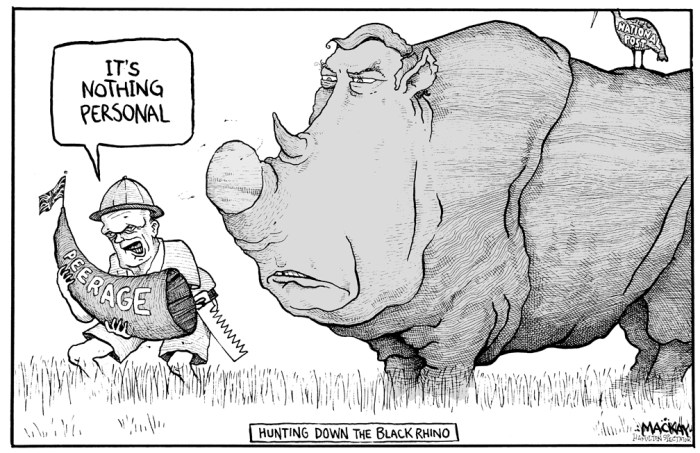
A Black day for our society

My morning paper, whose past and present principal proprietor was and is Lord Thomson of Fleet, has come to the aid of Lord-in-waiting Conrad Black whose patron, the leader of the British Tory party, has nominated him to membership in the British House of Lords. Black is, among other things, also a Canadian citizen and as such would need special dispensation from the Canadian governmentto waive a longstanding Canadian codicil which prevents its citizens accepting foreign titles.

Conrad Black Cartoon Gallery

This proves an inconvenience to Black who enjoys duel citizenship, Canadian and British, who lives in Great Britain and publishes newspapers here, there, and elsewhere, and has been awarded the Order of Canada, and been made a Privy Councillor by Brian Mulroney. The inconvenience is a trifling one; all Black need do to become a British Lord is resign his Canadian citizenship. Or he could also decl ine the honour of a Lordship and seek to be knighted, and become Sir Conrad.

It is easier to enter the House of Lords than to become a knight. Some are born to the Lords, others arrive there as failed or defeated politicians, or as retirees; like our own upper chamber, the senate, it is as much a place for the unexceptional as for the opposite. Still – an important difference – senators have to show up or risk penalty and censure; not all the Lords hope, or are expected, to sit.

In Britain, with its rigid class structure, being a lord or a lady provides added cashet, the title worn like a bauble, suggesting importance, breeding, wealth, and exclusivity. The appointments are high patronage; Lloyd George, whose understanding of the British class system was acute, sold peerages as one might trade in pork-bellies, transactions designed to pack the House of Lords for the purp ose of curbing its powers. But yet, the House of Lords remains a surviving bastion of one of the many remarkable, uniquely British creations, which is a society arbitrarily divided by class, defined as much by title as much by estate, and maintained by long-prevailing habit of deference and snobbery.

Canada was vulnerable to the same artificiality and pretension; we were, after all, first a British colony, then Dominion, and after that, part of the British Commonwealth of Nations. Until Mackenzie King, nearly all our prime ministers were knighted; the British monarch was our monarch (and still is), and not until Vincent Massey was there a Canadian Governor General at Rideau Hall. We have King to thank for the development of our own egalitarian society and for its preference for meritocracy and its contempt of aristocracy. As part of our determination not to become a forelock-tugging, bowing, scraping, watery imitation of the real British thing, we worked on our own model which maintained the Crown, but we finally sang our own anthem and flew our own flag.

It was also our determination not to consent to patronage bestowed by a foreign state that would enable a Canadian to sit and vote in the legislative chamber of that state.

My morning paper argues that this inhibition, which now provokes Conrad Black, is a relic of our past colonial mentality – “our pyschic inferiority complex.” But in this new, expanded, corporate one-world there lurk – as Lloyd George so quickly discovered almost a century ago – dozens of lusting moguls who would cheerfully support or underwrite any foreign party or power for the prize of a title for themselves (and another for the little woman). One must ask, in this small but pertinent matter, whose “inferiority complex” are we really discussing?

My morning paper reports that Black “has long cherished the idea of . . . being made a British peer.” If he has, he can easily cherish the reality, accept the gift of the British Tory party, and take his seat. But why should Canadians, or their government, allow for an exception in his case, and thus cheapen and degrade our own honours and hard-earned national values, and invite others to follow?

In the end, Toronto and Ottawa would be overrun by Canadian lords and ladies, the tables of the rich and famous would resemble those of baronial halls of old, surrounded by limousines and outriders, while peasants and social journalists stand beyond the gates to gape in awe and wonder at the new society wrought by Lord Black, in his finest hour.

The Prime Minister is being upbraided by the National Post, and the Globe and Mail, for daring to delay accommodating Mr. Black. I hope he will not cave in simply to get a better press. At the moment, Jean Chretien has more supporters among the people of Canada than the combined circulation of all the papers of all the lords of the Canadian press. – Dalton Camp (Toronto Star, 6/23/1999, A21) 

Posted in: Canada Tagged: Black, Canada, Conrad Black, horn, hunter, Jean Chretien, peerage, pith helmet, Rhino, rhinosaurus

Thursday April 1, 1999

April 1, 1999 by Graeme MacKay

Editorial Cartoon by Graeme MacKay, The Hamilton Spectator – Thursday April 1, 1999

Canadian Map ReDrawn For First Time in 50 Years

Bitter cold didn’t keep revellers from enjoying traditional Arctic games during festivities in Iqaluit in honour of Nunavut, Canada’s new territory.  With games, feasts, pride and hope, people across the eastern Arctic said goodbye to the old Northwest Territories yesterday and took their place as residents of Nunavut, Canada’s new territory.”Let the rest of the world know that we have our own culture, and they’re going to get to know us, ” a beaming Sila Kelly said.

Subject of a scholarly presentation on Cartographic misrepresentations of Nunavut, Canada

In Iqaluit, the Nunavut capital, about 150 people braved bitter winds that chilled the air to -42 C as they gathered outdoors for traditional Arctic games such as harpoon tossing and nusuuraut, a four-way tug-of-war.

Smiles may have been a bit forced in the teeth of north winds gusting up to 60 km/h. But there was nothing forced about the joy.

“I think our culture and language will be strengthened, ” Ruth Kadlutsiak said, especially for her three children and the next generation of Inuit.

“It’ll build up their self-esteem. Everybody is so proud of what they’ve accomplished here.”

Joelie Sanguya, who travelled to Iqaluit from further up Baffin Island at Clyde River for the celebration, said this is what the Inuit have waited for for years.

“Inuit people have been put aside and have had everything done by the government. This sort of thing is where the Inuit will have some input.

“I’m looking forward to seeing it.”

Nunavut was born out of the 1992 Nunavut Land Claim Agreement, under which the Inuit agreed to give up any future aboriginal rights to their traditional land in return for the power to govern their own territory. The western half of the old territory will continue to be known as the Northwest Territories.

Iqaluit’s celebrations were being mirrored in communities throughout the North in festivals that will last several days.

Pangnirtung will stage a seal hunt. Grise Fjord will have a seal cleaning contest.

On the western shore of Hudson Bay, Arviat will hold dog sled races and an igloo-making contest.

But the main focus will be on Iqaluit. By the time festivities end today, Nunavut will have sworn in its judges and its MLAs, inaugurated its own division of the RCMP, and held its first session of the legislature.

Marvellous Maps

There will also be a full measure of pomp and ceremony. At a community feast, Prime Minister Jean Chretien and Governor General Romeo LeBlanc will get a chance to sample traditional northern delicacies including caribou and raw seal.

The formation of Nunavut is the first redrawing of the Canadian map since the entry of Newfoundland — which celebrated its 50th anniversary yesterday.

The new territory, formed from the eastern half of the old Northwest Territories, will cover 2.2 million square kilometres of tundra, ice cap and rock, frozen coast — more than twice the area of Ontario.

That vast expanse is populated by only about 25,000 people — not even enough to fill a football stadium. About 85 per cent are Inuit who face unemployment, poverty, low education and substance abuse. (Source: Canadian Press)

Part of a traveller Editorial Cartoon Expo organized by the Inuit Tapiriit Kanatami called Polar Lines. Profile by the Nunatsiaq News.  Post by Guy Badeaux at Bado’s Blog.


Letter to the Editor

April 8, 1999, The Hamilton Spectator

Trivial and Stereotypical Nunavut Cartoon

Letters were written complaining about my perpetuation of stereotypes regarding Canada’s far north and the people who inhabit the region. I think people took particular umbrage at my reference to the “Eskimo Pie Factory”. During my childhood my grandmother often offered my siblings and I “Eskimo Pies”, rectangular shaped chocolate covered ice cream wrapped in paper. What seemed to be inoffensive in 1979, caused some to bristle, as demonstrated in the letter to the editor in1999, and is completely accepted as offensive to Canadians in 2019.

As social science teachers we frequently use political cartoons as teaching tools.

Students come to appreciate that, in a democratic society such as ours, discussion, dissent and debate are encouraged and that the opinion pages of newspapers provide a forum for public comment.

Whenever students consider an editorial or political cartoon, they assess whether it is fair. In our view, cartoonist Graeme MacKay’s Nunavut cartoon published April 1 provides a prime example of unfair and inappropriate commentary.

As teachers, we must always strive to provide a balanced view of events while demonstrating a sensitivity to all those involved; this certainly is essential with the present situation in Kosovo.

Unfortunately, all that MacKay has accomplished in his cartoon is to provide a tired stereotype of Canada’s North as a barren and frozen wasteland (eg. Gawdforsaken Island) of little value (eg. affordable beach-front property) and only suited for “Eskimo Pie” making and “cryogenic cadaver storage.”

To trivialize the historic Nunavut agreement regarding land settlement and aboriginal rights in this manner is insensitive and insulting. In the final analysis, MacKay has provided students with an example of how some political cartoons can be humourless and tasteless.

K. Darby, J. Kerr-Wilson, J. Lindeman, S. Lindeman, M. Livadiotakis, D. Patterson, P. Shuttleworth, BZamojc, Social Science Department, M.M. Robinson High School, Burlington.


Commentary, By Graeme MacKay, August 2, 2006

I’ve always been fascinated by maps. When I was a kid I declared to anyone who would listen that when I grew up I was going to work as a “mapmaker”. To train myself I would copy maps out of atlases and try to squeeze as many place names and geographic features as possible. Then I later found out that the correct name for “map making” was “cartography” and that in order to become a cartographer you had to be a whiz in mathematics. Knowing myself to be one of world’s worst math students on record I knew my dream of drawings maps for a living would never pan out.

Cartoonists have followed in the steps of previous generations who have found amusement in combining satire with maps. So I can only admire them as an observer. Some examples of maps be found through these Pinterest pages. Many of the example are, or inspired by the engravings of William Harvey, an English satirist working in the 1860’s. Upon their first publication, the artist described these maps as “humorous outlines of various countries, with an introduction and descriptive lines,” intended to make geography enjoyable and accessible to children. By today’s standards, some of these pictures might appear stereotypical, and even slightly offensive. However, at the time, they were quite popular, and they reflect the contemporary conceptions (or misconceptions) of these countries.

The editorial cartoon marking the creation of the new territory of Nunavut has not aged well, but serves as an example of evolving perceptions.

It’s important to keep an editorial cartoon that reflects changing perceptions, even if it includes outdated a non-native colonizer term for inuit like ‘Eskimo.’ This cartoon, made when Nunavut was created in 1999, jokes about remoteness using the term ‘Eskimo Pies.’ While it isn’t a term used today, keeping the cartoon helps us understand how language and attitudes have changed over time.

By discussing the cartoon’s language, we can talk about why terms like ‘Eskimo’ are now considered insensitive. It encourages us to think about how language affects how we see others. Keeping the cartoon lets us see how society has progressed and reminds us to be respectful of different cultures.

In short, the cartoon is a useful teaching tool. It shows us history and helps us talk about why being careful with our words matters.

Here are my maps drawn in the past 6 or so years, inspired by the works of artists like William Harvey:

May 9, 2006
May 9, 2006
September 28, 2004
September 28, 2004
September 14, 2004
September 14, 2004
May 30, 2003
May 30, 2003
June 20, 2002
June 20, 2002
May 16, 2002
May 16, 2002
December 16, 2000
December 16, 2000

Even more maps here:

Marvelous Maps

Posted in: Canada Tagged: Arctic, Canada, commentary, controversy, Feedback, isolation, maps, Nunavut, parody, territories

Saturday March 27, 1999

March 27, 1999 by Graeme MacKay

Reflecting on a 25-year-old editorial cartoon depicting nativist attitudes towards immigrants, the present-day resurgence of concerns over the northern border in Canada mirrors past sentiments, while acknowledging positive transformations in the country's immigration landscape, emphasizing the need for a balanced approach.

By Graeme MacKay, Editorial Cartoonist, The Hamilton Spectator – Saturday March 27, 1999

Weeding out foreign thugs

No country wants to be known as a place of refuge for suspected war criminals, least of all a liberal democracy like Canada. But with its immense, open border and its generous acceptance of the world’s refugees, Canada has been in danger of becoming known as such a haven.

A list of people the federal Citizenship and Immigration Department has deported in the past eight months illustrates how real the danger has been. For instance: 

– Fausto Reyes-Caballero, a chief of police in Honduras in the 1980s. He was part of a death squad. 

– José Annibal Cortez Cordon, a member of Guatemala’s police force. He persecuted guerrillas and participated in the destruction of villages. 

– Doru Popescu and Lionel Micu, who were with Romania’s Securitate and accomplices to atrocities. 

The presence of suspected war criminals in Canada is like a virus, sapping the good will of many Canadians and eroding Canada’s reputation abroad. What more justifiable target for anti-immigrant sentiment than war criminals? To have them living for years in ordinary Canadian neighbour- hoods fosters the repugnant idea that behind every refugee claimant lurks a criminal.

Canada is right to get rid of them as quickly as possible. If anything, it should invest more money and personnel into the effort to head them off before they arrive or to deport them if they succeed in getting in. 

Many of the recently deported thugs came to Canada in the 1980s at a time when thousands of desperate people were fleeing wars and civil unrest from Guatemala to Sri Lanka. Canadian immigration policy was not wrong when it decided that it is best to save the lives of refugee claimants and decide later who is genuinely fleeing persecution. But the government failed to allocate adequate funds to the determination of who should not be granted refugee status. 

Between 1989 and 1996, just 300 refugee claimants were deported from Canada for making false claims. That number shot up after April 1996, when the federal government set up a special section of the immigration department to concentrate on those suspected of war crimes or crimes against humanity. 

August 19, 1999

In 1997 alone, Canada deported 8,012 people, of whom 5,019 were failed refugee claimants. An unknown number of other claimants are believed to have left without being formally deported. 

Left behind in Canada, however, were more than 300 suspected war criminals. According to a government report, the immigration department could not deport these people because it did not know where they were. Embarrassed, the government gave the department $33 million in funding in July 1998, the majority of which went to the department’s war-crimes unit. This will be money well spent if it helps rid the country of people who participated in war crimes. 

Canada, with its low birth rate of 1.7 children per family, needs immigrants. The government’s failure to act vigorously against war criminals cannot be allowed to undermine the entire immigration and refugee program and Canada’s very future as a country. (Editorial – The Montreal Gazette, March 16, 1999) 

  *   *   *   *   *

Navigating Nativism Over 25 Years

The Canadian dream for immigrants has turned into a harsh reality, prompting growing pressure to reassess immigration policies in the face of economic challenges, housing struggles, healthcare complexities, and cultural clashes.

January 19, 2024

Looking back on my cartoon drawn 25 years ago, titled “Bring us your tired, your poor, your stone-throwing masses,” reveals unease. Crafted in the pre-9/11 era, it depicted immigrants laden with baggage labeled “grudges” and “hatred.” The accompanying editorial, “Weeding out foreign thugs,” addressed concerns about war criminals finding refuge in Canada.

In 1999, the editorial emphasized protecting Canada’s reputation while balancing compassion for refugees and national security. Fast forward to 2024, the focus has shifted to the northern border, with Republicans amplifying immigration concerns. This renewed attention mirrors a broader GOP trend, advocating for increased border security.

News: Republicans zero in on a new border — the one with Canada

Reflecting on my 1999 cartoon reveals persistent nativism, echoed today, especially among conservatives. Despite Canada welcoming millions since the late ’90s, fears of criminal exploitation persist. The irony is stark as a diverse society emerges.

Canada grapples with nativist attitudes, collaborating with the U.S. for border protection. In acknowledging the persisting nativism, the call is for a compassionate approach to immigration amidst ongoing challenges. (Graeme MacKay, January 28, 2024)

Posted in: Canada Tagged: "Silver Reflection", bigotry, Canada, diaspora, Editorial Cartoon, Immigration, intolerance, multiculturalism, nationalism, terrorism
« Previous 1 … 344 345 346 … 348 Next »
...Check it out and please subscribe!

Your one-stop-MacKay-shop…

T-shirts, hoodies, clocks, duvet covers, mugs, stickers, notebooks, smart phone cases and scarfs

2023 Coronation Design
Follow Graeme's board My Own Cartoon Favourites on Pinterest.

MacKay’s Virtual Gallery

Copyright © 2016 mackaycartoons.net

Powered by Wordpess and Alpha.

DMCA.com Protection Status
Loading Comments...