MacKay - Canadian Editorial Cartoons
mackaycartoons

Graeme MacKay's Editorial Cartoon Archive

  • Who?
  • Copyright
  • Boutique
  • Kings & Queens
  • Prime Ministers
  • Presidents
  • The French Monarchy Project
  • DOWNLOADS

christmas

Thursday December 15, 2022
December 15, 2022 by Graeme MacKay

Editorial Cartoon by Graeme MacKay, The Hamilton Spectator – Thursday December 15, 2022

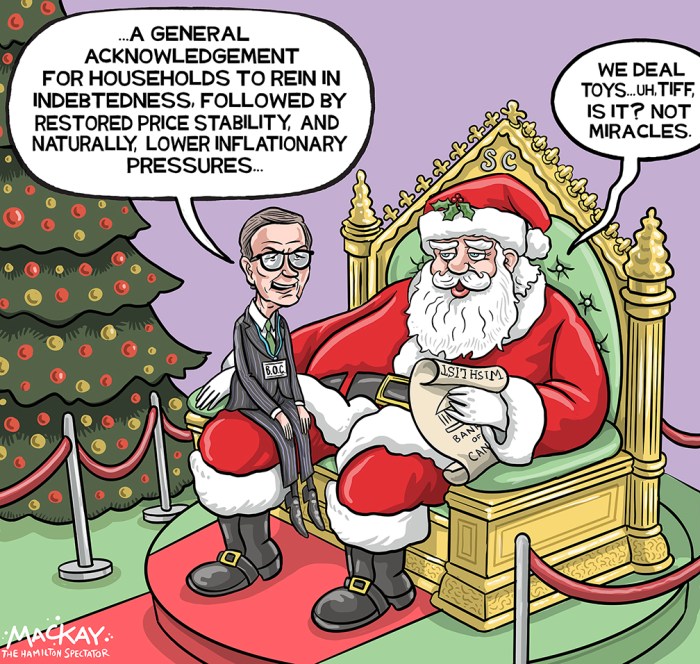
Household debt levels could cripple economy, economist warns

November 3, 2022

Canadian household debt levels have increased enough to spark a recession when combined with interest rate hikes, says one economist, after Statistics Canada released its latest report Monday.

Jim Stanford, the director of the Centre for Future Work, said the debt levels are high enough that, as interest rates rise, disposable income ordinarily spent on consumer goods is being used to pay debt.

“Chances are you’re going to see an increased interest bite from household budgets equal to about two or three per cent of GDP,” he said. “That alone is enough to put the economy into a recession, let alone the other impacts on business investment, for example.”

The standard definition of a recession is when the country’s gross domestic product (GDP) contracts for at least two quarters.

Household consumption accounts for more than 50 per cent of Canada’s GDP, Stanford said, making it the biggest single contributor to economic growth.

Stanford said $16 billion in additional interest payments made over three months is worth more than half of a percentage point of Canada’s GDP.

Statistics Canada’s new figures show for every dollar of disposable income in the third quarter of 2022 there was $1.83 in credit market debt. The figure is a slight increase from the previous quarter and up from $1.77 last year.

Thursday September 8, 2022

The figures come as the Bank of Canada has continued to raise its key policy rate. Last week it hiked the key policy rate another 50 basis points to 4.25 per cent in an effort to fight inflation.

Mortgage payments also hit Canadians hard with interest payments expanding by more than 16 per cent, which is the largest increase on record, according to the StatsCan report.

“It’s certainly hard evidence that the rising interest rates are wreaking havoc with household finances,” Stanford said. “We’ve never seen an interest shock like that to Canadian households before.”

He said he expects the situation to worsen in the coming months.

On Monday, Bank of Canada governor Tiff Macklem defended the interest rate hikes in Vancouver in front of the Business Council of British Columbia. He said they are working and the country needs to stay the course.

“If we under-tighten, inflation is going to stay too high. Canadians are going to have to continue to endure the hardship of higher inflation,” Macklem said.

He said the bank was surprised at how international events, like the Russian invasion of Ukraine and supply chain issues powered inflation.

He said such trends will make it more difficult to bring inflation down than it has been in the past. (The Toronto Star)

Posted in: Canada Tagged: 2022-42, Bank of Canada, Canada, christmas, debt, Economy, inflation, procreate, recession, Santa Claus, spending, Tiff Macklem

Tuesday December 13, 2022

December 13, 2022 by Graeme MacKay

Editorial Cartoon by Graeme MacKay, The Hamilton Spectator – Tuesday December 13, 2022

Premiers demand meeting with Justin Trudeau over health-care funding

Canada’s premiers are demanding more federal money from Ottawa for health care and they want a face-to-face meeting with Prime Minister Justin Trudeau to make their case.

August 24, 2022

The provincial and territorial leaders appealed to Trudeau on Friday for a first ministers’ meeting early in the new year to tackle the funding crisis in a pandemic-battered system.

While the federal government is willing to increase the Canada Health Transfer — the money Ottawa sends to the provinces on a per-capita basis for health care — it has repeatedly stated any commitment would come with strings attached to ensure the additional dollars go toward measurable, improved health outcomes for Canadians instead of flowing into provinces’ general revenues.

Responding to the premiers, federal Health Minister Jean-Yves Duclos declined to say whether Trudeau would agree to convening the meeting.

December 21, 2016

“The prime minister will obviously do what he wants to do. What he has asked me to do is to work with my colleagues — health ministers — to agree on the results and (put) therefore the ends before the means,” Duclos told reporters in Ottawa.

But he said there are conditions that must be met to achieve that goal, such as supporting health-care workers and patients; investing in home care, mental health care and long-term care; and implementing a modern health data collection system.

Duclos said his provincial and territorial counterparts have agreed to those conditions “in private,” and that it is now up to “premiers to let us do our job and express publicly the type of outcomes and results that we need to achieve together.”

Ontario Premier Doug Ford insisted provinces want the “flexibility to be able to move those funds around where they’re needed” since they deliver the front-line health services.

July 27, 2019

“We have no problem with accountability, transparency,” Ford said at the virtual meeting chaired by Manitoba Premier Heather Stefanson.

“Well, we need a funding partner. We need that funding for long-term care, we need it for home care, we need it for mental health and addiction, we need it for HHR, health human resources, infrastructure,” he said.

Discussions on boosting health-care funding fell apart when Ottawa said it was open to the increase if provinces and territories promised to build a national data collection system and expand the use of common health indicators — measures that show how well a health-care system is performing.

The provinces said they didn’t expect those conditions to be tied to a funding boost, and never saw concrete details on what such an increase would look like.

Stefanson said Friday that Ottawa has yet to present a proposal since that meeting.

Duclos, meanwhile, continued to insist that specific outcomes from the additional money must be clearly determined before any dollar figures are discussed.

“The premiers refuse to speak about those results. Everyone else wants to, but not the premiers,” he said.

Beyond Ottawa’s insistence on tying additional money to improvements in the system, the federal-provincial impasse also hinges upon differing views on current funding.

The premiers say their jurisdictions pay 78 per cent of health-care costs, with the federal government ponying up the remaining 22 per cent. They want Ottawa’s cash contribution to jump to 35 per cent. (The Toronto Star)


Posted in: Canada, Ontario Tagged: 2022-42, A Christmas Carol, Canada, christmas, Doug Ford, fending, healthcares care, Hospital, Justin Trudeau, money, Ontario, Scrooge

Saturday December 10, 2022

December 10, 2022 by Graeme MacKay

Editorial Cartoon by Graeme MacKay, The Hamilton Spectator – Saturday December 10, 2022

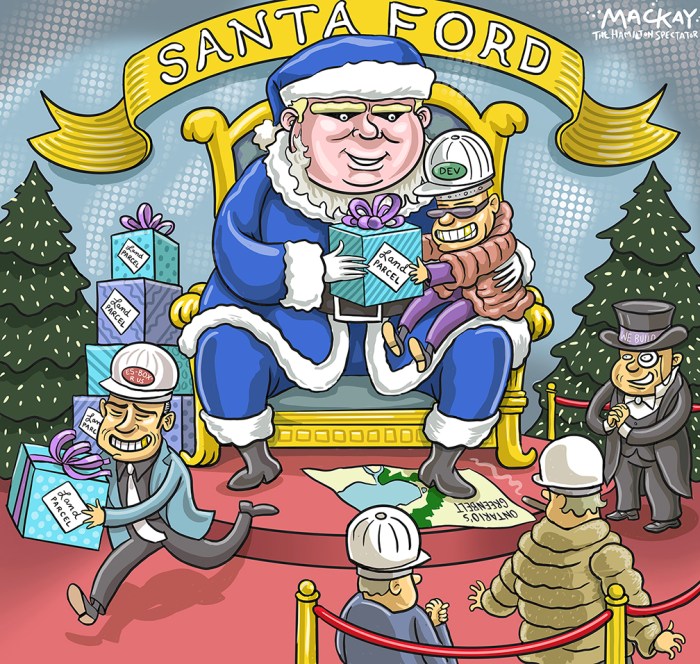
Bill 23: Doug Ford’s gift to Hamilton

November 30, 2022

This holiday season, let’s consider the gift that just keeps on giving — Bill 23. Not giving to everyone, mind you. But to those who do benefit, the Ford government’s law to build more and faster is a real gem.

Like the development industry overall, and specifically developers with plans and money to build more sprawl development on lands that used to be protected by being in the Greenbelt. They’re thrilled. Especially those who, coincidentally, purchased some of that land in the not-too-distant past, who will see the value of that land go sky-high as soon as the first developments are approved.

Isn’t that a stroke of good luck? They bought Greenbelt land, and it happened to be soon before the government announced it would make it available for development.

December 18, 2019

And even more coincidence — some of them donated a lot of money to the Progressive Conservative party of Doug Ford. What a crazy world.

You would almost think those developers knew something was coming. But that would mean that someone in the government told them, and Ford assures us that isn’t the case. So nothing to see here, the premier says everything’s just fine. Mind you, he’s the same premier who said not long ago that he wouldn’t authorize development on the Greenbelt, so perhaps his earnest assurances should be taken with a grain of salt.

December 18, 2018

And how about the people of the lovely town of Erin, not far from Guelph? To their surprise, they learned recently that 7,000 acres of their town and region are being added to the Greenbelt, part of the government’s pledge to replace more than what it is taking. Of course, most of the land in the area is agricultural and is being used for that purpose, and it’s unlikely it would ever give way to development in any event.

Erin folks now have Greenbelt protection they didn’t need in the first place.

In addition to the town of Erin, the province will also add into the Greenbelt 13 publicly owned lands in so-called Urban River Valleys across the Greater Toronto and Hamilton Area. Consider the words of Kevin Thomason of the Greenbelt West Coalition, who said to Torstar: “This is already protected land … this land is already owned by the government — the areas around creeks and rivers that face no development threat and had no possibility of ever being developed.”

December 10, 2020

Anyone see a trend here? Take prime agricultural land from areas like Niagara and the Duffins Rouge Agriculture Preserve, which have some of the best farming soil in the country, and replace them in the Greenbelt with lands that are not development candidates to begin with. Then call it an even swap. Clever, non?

New Hamilton city councillor Ted McMeekin, also a former provincial municipal affairs minister, today delivers a cogent and impactful summary of what is wrong with Bill 23. It’s recommended reading.

As is the story by Spec journalist Teviah Moro about the impact of the legislation on Hamilton’s tax base. Because Bill 23 removes or reduces development fees from much new construction, Hamilton will forego revenue of between $14 million and $25 million each year. That revenue would typically go to pay for infrastructure such as sewers, roads, bridges and services to support new housing.

November 23, 2022

Here again, developers certainly win by paying lower or no development charges. They get improved profitability, while Hamilton and its taxpayers get — well — Scrooged.

Fortunately, Municipal Affairs and Housing Minister Steve Clark says municipalities hit hard by revenue losses could be “made whole,” assuming the province agrees with their business case. Mind you, he was talking about Toronto especially, and also about getting the federal government to use its Housing Accelerator Fund to compensate municipalities.

So, the province changes the rules causing municipalities to lose millions, then it says it’s up to Ottawa to fix the revenue shortfall created by provincial policy. See how they did that?

There you have it — Bill 23, the gift that keeps on giving. Thanks Santa Doug. (The Hamilton Spectator)


Posted in: Ontario Tagged: 2022-41, bill 23, builder, christmas, developer, Doug Ford, green belt, land parcel, Ontario, presents, procreate, Santa Claus

Friday December 9, 2022

December 9, 2022 by Graeme MacKay

December 9, 2022

Editorial Cartoon by Graeme MacKay, The Hamilton Spectator – Friday December 9, 2022

Inflation is changing how Canadians do Christmas

A new poll by the Angus Reid Institute says more than half of Canadians – 56 per cent – say they will be spending less on Christmas, including presents and entertaining.

September 29, 2022

“When you look at the Atlantic Canadian data, among the highest numbers in the country in Nova Scotia, 57 per cent, say they’re worse off now,” said Dave Korzinski, the research director with Angus Reid Institute.

“In Newfoundland and Labrador, 54 per cent, in New Brunswick 53 per cent, all of those are higher than the national average of 50 per cent,” Korzinski said.

This is the first time the non-profit’s data has shown that more than 50 per cent of Canadians say they are financially worse off this year than this time last year.

“Seeing food banks across the country who are dealing with essentially budgets that are smaller and demand that is larger, which is a really tough recipe when you’re trying to keep your programs going,” Korzinski said.

“When it’s more expensive for your household, imagine buying it for 1,400 households,” said Alex Boyd,  the executive director Greener Village Food Bank in Fredericton.

May 10, 2022

“So, that’s what we do with milk and eggs, those are very seldom donated items,” Boyd said.

Charitable giving is also already down this holiday season, according to the poll.

“To see 37 per cent of Canadians say they’re cutting back on donations, including more than two-in-five who are older, who are 55+ who tend to be the most generous and the most consistent givers, has been really challenging for a lot of charities,” Korzinski said.

“It’s always a concern that we watch for, especially being an organization that relies heavily on November and December giving to make up for the leaner months earlier in the year,” Boyd said.

Eighty-seven per cent of Canadians say they have cut back on spending in some way recently – up from 80 per cent in August. (CTV) 


Posted in: Canada, Lifestyle Tagged: 2022-41, affordability, banks, christmas, Christmas tree, cost of living, inflation, Interest rates, mortgages, recession, utilities

Wednesday December 7, 2022

December 7, 2022 by Graeme MacKay

Editorial Cartoon by Graeme MacKay, The Hamilton Spectator – Wednesday December 7, 2022

Get’em while you can: Hamilton Christmas tree hunters scrambling amid shortage

Don’t dally, Christmas tree hunters: some local farms are already out of seasonal evergreens amid a chronic shortage exacerbated by inflation and extreme weather.

December 4, 2021

In the Hamilton area, several tree farms are warning their fields could be bare by next weekend — while a few are already sold out or not opening at all.

Jim Watson is selling only pre-cut evergreens this year — and only on weekends — because a series of “terrible, dry summers” wiped out fields of trees that might otherwise be open for the U-cut crowd.

But that didn’t stop eager tree hunters from flooding his Mount Hope farm the day it opened Nov. 26. “People are really trying to get a tree early,” Watson said, adding he would be surprised if he has enough pre-cut fir, spruce and pine to stay open beyond the Dec. 10 weekend.

Posted in: Canada, Lifestyle Tagged: 2022-41, affordability, car, christmas, Christmas tree, consumer, cost of living, supply chain, tree, xmas
« Previous 1 … 4 5 6 … 17 Next »
...Check it out and please subscribe!

Your one-stop-MacKay-shop…

T-shirts, hoodies, clocks, duvet covers, mugs, stickers, notebooks, smart phone cases and scarfs

2023 Coronation Design
Follow Graeme's board My Own Cartoon Favourites on Pinterest.

MacKay’s Virtual Gallery

Copyright © 2016 mackaycartoons.net

Powered by Wordpess and Alpha.

DMCA.com Protection Status
Loading Comments...