MacKay - Canadian Editorial Cartoons
mackaycartoons

Graeme MacKay's Editorial Cartoon Archive

  • Who?
  • Copyright
  • Boutique
  • Kings & Queens
  • Prime Ministers
  • Presidents
  • The French Monarchy Project
  • DOWNLOADS

Budget

Saturday March 16, 2024

March 16, 2024 by Graeme MacKay

Ford's fiscal policies, including the unconstitutional Bill 124, have led to mismanagement and harm to essential workers and taxpayers, reflecting a pattern of ideological posturing and reckless spending detrimental to Ontarians' well-being.

Editorial Cartoon by Graeme MacKay, The Hamilton Spectator – Saturday March 16, 2024

The Costly Failure of Ford’s Fiscal Policies

October 5, 2012

In a time when fiscal responsibility should be paramount, the Ford government’s mismanagement of taxpayer money has reached unprecedented levels. The recent revelation that Ontario is on the hook for over $6 billion in payments to public sector workers due to the unconstitutional nature of Bill 124 is just the latest in a series of fiscal blunders. 

Bill 124, which capped salary increases for broader public sector workers at one per cent a year for three years, was not only legally flawed but also morally reprehensible. The government’s attempt to impose such stringent wage restraints on essential workers during a global pandemic was nothing short of callous. Rather than bargaining in good faith with unions, the Ford government opted for an ill-conceived legislative attack that backfired spectacularly.

Opinion: Bill 124 is no more: Good riddance to bad legislation 

June 9, 2020

This was not just about fiscal prudence; it was about ideological posturing. Ford’s attempt at union-busting and pandering to his anti-labour base failed miserably, at the expense of Ontario’s workers and taxpayers alike. The wasted tax dollars spent on fighting legal battles that were doomed to fail could have been better allocated to essential services like healthcare. 

Moreover, the Ford government’s record on spending is alarming. Despite promises to rein in excessive government spending, Ford has presided over a 27 percent increase in spending since taking office. This reckless approach to fiscal policy is unsustainable and ultimately detrimental to the well-being of Ontarians. 

News: Ontario has to pay public sector workers $6B and counting in Bill 124 compensation 

November 2, 2022

The repeal of Bill 124 is a welcome development, but it comes too late for the nurses, teachers, and other public sector workers who were unfairly impacted by its constraints. The government’s failure to recognize the detrimental effects of its policies on the healthcare system, particularly during a staffing crisis exacerbated by the pandemic, is a testament to its lack of foresight and empathy. 

Ontarians deserve better. They deserve a government that prioritizes their needs over political posturing. It’s time for the Ford government to acknowledge its mistakes, learn from them, and chart a new course that prioritizes the well-being of all Ontarians, not just a select few. The cost of failure is too high to ignore. (AI)


Posted in: Ontario Tagged: 2024-06, Bill 124, Budget, Doug Ford, education, health care, nurses, Ontario, Peter Bethlenfalvy, public sector, teachers, Wage cap

Friday January 26, 2024

January 26, 2024 by Graeme MacKay

Ontario's hospitals and universities are facing major financial challenges, resorting to loans and projecting deficits, underscoring the urgent need for increased government support to safeguard essential services in healthcare and education.

Editorial Cartoon by Graeme MacKay, The Hamilton Spectator – Friday January 26, 2024

Ontario’s Double Whammy: Ailing Healthcare and Struggling Universities

August 3, 2022

In a strange dance of financial distress, Ontario finds itself caught between the ailing health care system and struggling universities, both desperately seeking a remedy for their budgetary ailments.

Joanna Frketich’s recent report in The Hamilton Spectator paints a grim picture of Ontario hospitals grappling with deficits in the tens of millions. Hamilton Health Sciences (HHS), Brantford Community Health System (BCHS), and Burlington’s Joseph Brant Hospital are all resorting to loans and lines of credit to cover shortfalls. As Doris Grinspun, CEO of the Registered Nurses’ Association of Ontario, aptly puts it, “Efficiency has become deficiency.”

News: Area hospitals using loans, lines of credit to pay for care

August 30, 2023

Simultaneously, Kristin Rushowy’s report for the Toronto Star reveals that almost half of Ontario’s universities are drowning in deficits. (Hamilton’s McMaster University is for now bucking the trend.) Steve Orsini, head of the Council of Ontario Universities, warns that student services are on the chopping block unless the government steps in. It’s a financial tug-of-war between two pillars of society, both left teetering on the edge.

The situation in both sectors is no laughing matter, but one can’t help but wonder if the province’s decision-makers are secretly moonlighting as scriptwriters for a tragicomedy. Picture this: hospital CEOs and university administrators engaging in a bizarre game of financial limbo, each trying to outdo the other in how low they can go in their budgetary dance.

News: Almost half of Ontario universities are running deficits, putting student services at risk, council says

March 1, 2023

In this precarious ballet, hospitals and universities are forced to tap into lines of credit and loans just to keep their operations afloat. As the deficits mount, it seems like the only growth industry in Ontario is the debt market. The irony is glaring – a province known for its robust healthcare and education systems now forced to juggle financial burdens that threaten the very foundations of these institutions.

The Ontario Hospital Association (OHA) suggests that the province has chosen not to enforce accountability agreements mandating balanced budgets for hospitals. On the other side of the stage, universities are pleading for a boost in funding and the leeway to increase tuition fees. The government, it seems, holds the purse strings to a performance that impacts the well-being of both patients and students.

September 11, 2015

In this unfortunate duet, the people of Ontario are left as spectators, watching their essential services spiral into uncertainty. It’s time for the government to rewrite the script, providing the necessary financial support to ensure the stability of healthcare and education. The province’s future depends on it, and the citizens of Ontario deserve more than a front-row seat to a financial tragedy.

Posted in: Ontario Tagged: 2024-02, Budget, education, Finance, health care, Hospital, Ontario, Payday, University

Thursday September 28, 2023

September 28, 2023 by Graeme MacKay

Editorial Cartoon by Graeme MacKay, The Hamilton Spectator – Thursday September 28, 2023

Municipal Budget Woes: The Balancing Act Amid Rising Costs

March 24, 2007

In Ontario, municipalities are currently navigating treacherous financial waters, trying to maintain essential services while grappling with budget shortfalls. The pressures to raise property taxes loom large, but it’s a precarious path to tread, especially at a time when citizens are already stretched thin by rising inflation, borrowing costs, and a cost of living crisis. The recent budget discussions in Hamilton serve as a stark reminder of the anxieties that homeowners face.

News: City says 14.2 per cent tax increase looming for Hamilton next year  

August 22, 2012

Coun. Tom Jackson’s recent question in Hamilton hit a nerve: with skyrocketing property values since the last assessment in 2016, many homeowners feared their taxes would double or worse. The reality, as explained by Carmelo Lipsi, the vice-president and COO of the Municipal Property Assessment Corporation (MPAC), is far less dire. Reassessment doesn’t automatically double your taxes; it just redistributes the tax burden.

The reassessment process is based on a complex set of factors, including real estate activity, property size, location, and construction quality. When the reassessment occurs, it compares the change in your property’s assessed value to the average change for similar properties in your municipality. If your property’s increase exceeds the average, you may expect to pay more taxes; if it’s below, you might see a reduction.

August 14, 2014

In areas with rapidly rising property values, homeowners may face tax increases, while those in more stable areas could see a reduction. Additionally, area rating in Hamilton, where different parts of town pay varying amounts for different services, further complicates the tax calculation.

It’s crucial to note that reassessment isn’t the only factor affecting taxes. Council-approved tax increases also contribute to changes in property tax bills. However, the idea that reassessment alone could double or triple taxes is a misconception.

The situation isn’t unique to Hamilton. Brockville is also facing budgetary challenges, with inflation, rising costs, and unforeseen expenses impacting the 2023 budget. A reliance on fiscal policy reserves and the need to find sustainable revenue sources loom large.

Analysis: As Ontario rolls in tax dollars, why are its cities so cash-strapped?

July 21, 2023

Oshawa, on the other hand, is exercising Strong Mayor powers to expedite budget decisions as part of a broader commitment to building 1.5 million homes by 2031. While these powers grant mayors greater control over budgets, the impact on housing remains uncertain.

In Toronto, Mayor Olivia Chow’s proposal for a city sales tax was met with mixed reactions. The city faces a substantial budget shortfall, and while the sales tax idea seems off the table for now, it highlights the challenging choices municipalities must make to bridge budget gaps.

Ultimately, municipalities in Ontario are navigating a complex financial landscape, and their perennial default is often to seek support from other levels of government. Raising property taxes, while often necessary to fund essential services, must be done judiciously, considering the economic pressures on residents. The reassessment process may not be the doomsday scenario some fear, but it’s a reminder of the delicate balance that local governments must strike when managing budgets in trying times. The key is transparency, communication, and a commitment to ensuring the burden of taxation remains fair for all residents. (AI)


Posted in: Hamilton, Ontario Tagged: 2023-17, Budget, cost of living, dominoes, federalism, Hamilton, inflation, Municipality, Ontario, property tax, tax

Saturday June 10, 2023

June 10, 2023 by Graeme MacKay

Editorial Cartoon by Graeme MacKay, The Hamilton Spectator – Saturday June 10, 2023

Pierre Poilievre’s Theatrical Filibuster Fails to Deliver Solutions

Conservative Leader Pierre Poilievre’s recent four-hour-long filibuster in the House of Commons may have garnered attention, but it was ultimately an empty display of theatrics. Poilievre’s bombastic speech touched on various topics, including historical references and monetary policy, but it lacked substance and failed to provide any tangible solutions. It became clear that his primary goal was to draw attention to himself rather than address the pressing issues facing Canadians.

March 1, 2003

Poilievre’s filibuster came at a time when wildfires were ravaging vast regions of Canada and blanketing much of the U.S. northeast in thick smoke and acrid orange skies. These devastating fires are not isolated incidents but rather a direct consequence of climate change. Scientific research has established a clear link between rising global temperatures, prolonged droughts, and the increase in the frequency and intensity of wildfires. It is disheartening that Poilievre chose to focus solely on budget-related matters and ignored the pressing issue of climate change that was affecting the lives of countless Canadians.

Opinion: I listened to all four hours of Pierre Poilievre’s fake filibuster. Here are 7 things I learned  

June 10, 2021

The urgency to address climate change and its catastrophic consequences cannot be overstated. Governments, policymakers, and individuals must acknowledge the reality of this crisis and take immediate action to mitigate its effects. This includes reducing greenhouse gas emissions, transitioning to renewable energy sources, protecting vulnerable ecosystems, and implementing sustainable practices. Denial and skepticism have no place in the face of overwhelming scientific evidence.

Poilievre’s attempt to exploit the wildfires for political gain during his debate with Prime Minister Justin Trudeau was nothing short of opportunistic. Instead of engaging in meaningful discourse about the Bank of Canada’s interest rate hike and the budget, he resorted to personal attacks and distractions. It is evident that Poilievre’s priority lies in winning the next election rather than addressing the concerns of Canadians in a substantive and constructive manner.

May 13, 2015

While Poilievre claims to champion the issue of the cost of living, it is worth noting that climate change is of greater concern to a wider audience. The impact of climate change on the environment, public health, and the economy cannot be ignored. Poilievre’s dismissal of the carbon tax and clean fuel regulations as “Trudeau taxes” undermines the importance of market-based methods for reducing consumer emissions. His proposed solution of axing these measures without providing viable alternatives is short-sighted and misguided.

Opinion: Mr. Poilievre’s Hollywood filibuster  

March 3, 2022

Moreover, Poilievre’s reliance on selective facts and dubious claims further undermines his credibility. His speech was filled with unsubstantiated statements that crumble under scrutiny. Canadians deserve leaders who are honest, transparent, and accountable, rather than individuals who manipulate facts for political gain.

Pierre Poilievre’s filibuster was a spectacle designed to capture attention rather than offer meaningful solutions. While he may have garnered temporary media coverage, his theatrics did not hold up to scrutiny or contribute to productive debate. It is imperative that Canadian politicians prioritize addressing the urgent challenges posed by climate change and work towards viable solutions rather than indulging in empty rhetoric and political posturing. (AI) | Editorial cartoon also printed in the Toronto Star.


Editorial, The Hamilton Spectator – Saturday June 10, 2023

Where There’s Smoke…

Record wildfires and the resulting smoke pollution were on every Canadian tongue this week. But not in our seats of government.

Oh, it came up at Queen’s Park. The Opposition NDP raised the crisis and asked the government to officially link the growing wildfire threat to climate change. Ford declined, accusing the NDP of politicizing the crisis and arguing that the fires were started by humans, not climate change.

And in Ottawa, Pierre Poilievre was filibustering the federal budget, which he had no chance of stopping or even slowing down. Wildfires and smoke weren’t even on his radar.

Climate change isn’t starting wildfires. It is making the season longer, making them bigger and more frequent. You would think even hard-core partisans like Ford and Poilievre could get their heads around that, but you’d be wrong.
 

Posted in: Canada Tagged: 2023-11, Budget, Canada, cost of living, Economy, filibuster, leadership, Pierre Poilievre, recession, showboat, wildfire

Tuesday March 28, 2023

March 27, 2023 by Graeme MacKay

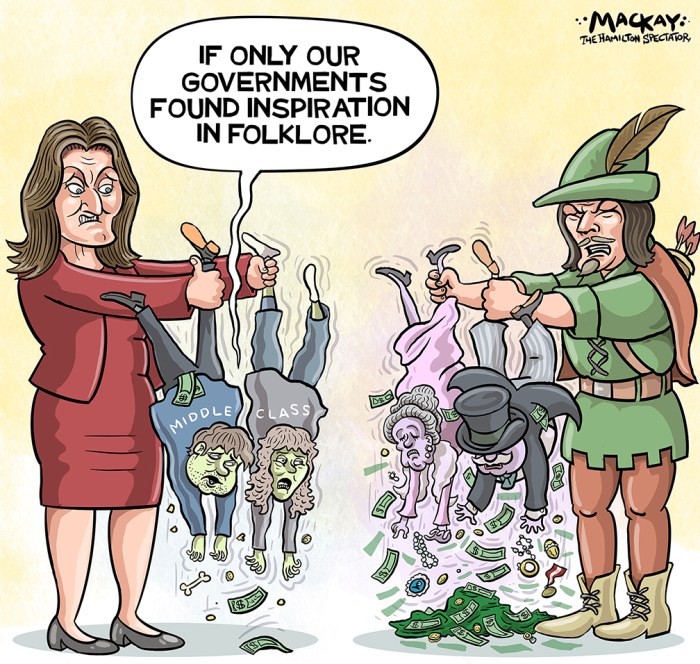
Editorial Cartoon by Graeme MacKay, The Hamilton Spectator – Tuesday March 28, 2023

Freeland Promises Affordable Life for Canadians with Budget 2023, But Taxes and Spending Raise Doubts

January 24, 2023

Oh joy, it’s that time of year again: Budget season. On March 28, Finance Minister Chrystia Freeland is set to release the government’s plan to make life more affordable. But don’t get too excited, middle-class Canadians, because just four days later, taxes will be hiked. And it’s not just one tax increase – it’s several. Federal alcohol taxes are going up by 6.3%, adding to the already exorbitant taxes Canadians pay for their brews. Carbon taxes are also increasing, with the average household facing a bill of between $402 and $847 after rebates. And that’s not all. Payroll taxes will cost those making $66,600 or more an extra $305 this year. Feeling more affordable yet?

Prime Minister Justin Trudeau may tout his government’s $10-a-day childcare, GST rebate, dental care, and housing benefit, but let’s not forget that it’s all being paid for with borrowed money. And with the debt reaching $1.2 trillion and interest charges totaling $35 billion annually, Trudeau’s borrowing is only delaying the bill to taxpayers. So much for making life more affordable.

November 3, 2022

The government could show some spending restraint and make life more affordable for Canadians, but don’t hold your breath. Freeland already overspent by $20 billion in just seven months last year. And while there will be some measures aimed at helping Canadians, like an extended GST tax credit and a higher ceiling for withdrawing money from education savings plans, it’s not enough to outweigh the tax increases and borrowing.

News: Chrystia Freeland’s federal budget will tackle high cost of living: sources

Perhaps if the government took a more balanced approach to spending and taxation, Canadians could actually feel some relief from the pressure on their wallets. But until then, it seems like we’ll just have to get used to being overtaxed and overburdened. Cheers to that! (AI)

Posted in: Canada Tagged: 2023-06, affordability, Budget, Canada, Chrystia Freeland, cost of living, middle class, poor, procreate, rich, robin hood
« Previous 1 2 3 4 … 23 Next »
...Check it out and please subscribe!

Your one-stop-MacKay-shop…

T-shirts, hoodies, clocks, duvet covers, mugs, stickers, notebooks, smart phone cases and scarfs

2023 Coronation Design
Follow Graeme's board My Own Cartoon Favourites on Pinterest.

MacKay’s Virtual Gallery

Copyright © 2016 mackaycartoons.net

Powered by Wordpess and Alpha.

DMCA.com Protection Status
Loading Comments...