MacKay - Canadian Editorial Cartoons
mackaycartoons

Graeme MacKay's Editorial Cartoon Archive

  • Who?
  • Copyright
  • Boutique
  • Kings & Queens
  • Prime Ministers
  • Presidents
  • The French Monarchy Project
  • DOWNLOADS

superman

Thursday July 17, 2025

July 17, 2025 by Graeme MacKay

Prime Minister Mark Carney employs diversification and worker support to navigate the challenges posed by U.S. tariffs on Canadian steel.

Editorial Cartoon by Graeme MacKay, The Hamilton Spectator – Thursday July 17, 2025

Also printed in The Toronto Star.

Navigating Uncertainty with Strategic Resilience

Canada's steel industry faces turmoil as Trump's tariffs and unresolved steel dumping issues challenge North American trade relations.

June 5, 2025

In the complex and often tumultuous world of international trade, Canada’s steel industry finds itself at a precarious crossroads. With the imposition of a 50% tariff on Canadian steel and aluminum imports by U.S. President Donald Trump, challenges have arisen that require astute leadership and strategic foresight. Prime Minister Mark Carney, confronted with an unconventional U.S. administration, has embarked on a path that prioritizes resilience, diversification, and support for Canadian workers.

The crux of the issue lies in the stark imbalance of economic power between Canada and the United States. With 90% of Canada’s steel exports traditionally directed to the U.S., the impact of these tariffs cannot be underestimated. President Trump’s steadfast determination to impose tariffs on foreign steel, regardless of existing trade agreements like CUSMA, places Canada in a difficult position. In such a dynamic landscape, Carney’s approach to diversify Canada’s trade relations and reduce dependency on a single market is not just prudent—it is essential.

News: Steel producers warn of dire consequences of 50% tariff if broader U.S. trade deal isn’t reached

Trump's tariffs on aluminum and steel risk harming U.S. consumers and jobs, while Canada's retaliation highlights global trade tensions.

March 13, 2025

Diversification acts as a safeguard against the volatility of U.S. trade policies. By opening new markets and exploring opportunities beyond the immediate neighbour, Canada can reduce its vulnerability to sudden policy shifts. This strategy not only strengthens the steel sector but also aligns with broader national interests in building a more resilient and self-reliant economy.

In tandem with diversification, Carney’s commitment to supporting Canadian steel workers is a crucial component of his strategy. The allocation of $70 million for training supports and $1 billion for technological advancement within the steel industry underscores a forward-thinking approach. By investing in skills development and innovation, Canada is not merely reacting to current challenges but preparing its workforce for the future.

News: Carney cracks down further on cheap steel imports into Canada in bid to protect domestic mills

Chrystia Freeland’s assurances that Canada will be “absolutely fine” under a Trump presidency lack specificity, leaving Canadians skeptical and searching for real solutions amid mounting challenges.

November 8, 2024

Moreover, the introduction of tariffs on non-free trade countries and reciprocal measures for free-trade partners reflects a balanced response to unfair competition. By reducing the influx of cheap imported steel into Canada—some of which finds its way to the U.S.—Carney addresses a significant concern of the U.S. administration. This measure could open a pathway to a more integrated North American steel market, potentially leading to reduced U.S. tariffs on Canadian products and fostering a collaborative trade environment.

Carney’s measured response, with a focus on long-term sustainability, contrasts with the unpredictability of the current U.S. administration. While President Trump’s policies may be driven by immediate gains and protectionist inclinations, Canada’s approach is rooted in a broader vision of economic stability and growth.

Analysis: Six things Trump should know about Liberia after he praised leader’s ‘good English’

Navigating the challenges posed by an unconventional U.S. presidency requires careful consideration and strategic action. Prime Minister Mark Carney’s emphasis on diversification, worker support, and industry investment demonstrates a commitment to safeguarding Canada’s steel industry. This multifaceted approach not only addresses immediate concerns but also lays the groundwork for a more robust and resilient economic future. As Canada treads carefully in these uncertain times, the path forward is illuminated by a focus on innovation, inclusivity, and international collaboration.


Savvy Man of Steel

My editorial cartoon in the Thursday edition of the Hamilton Spectator: https://www.thespec.com/opinion/editorial-cartoons/mark-carney-prime-minister-of-steel/article_6f7ba0f7-71f9-5666-86bf-58a3679d87fe.html

Living in Canada’s steel capital, Trump’s 50% tariff on our steel is a real blow, impacting both businesses and everyday lives. Normally, I’d capture this in a cartoon, but a recent trip out west left me short on time.

Trump’s awkward remarks to the Liberian President highlighted his ignorance, echoing the kind of erratic and, frankly, stupid trade policies we’ve seen from him. Prime Minister Mark Carney is addressing this lunacy by diversifying our trade ties and investing in our steel workers’ skills and tech upgrades, making sure we’re not overly dependent on the U.S.

Carney’s approach to fair trade, including strategic tariffs, aims to shield Canadian interests and could lead to better cooperation in North America’s steel market. While Trump seems focused on quick wins, Carney is thinking about the long haul, emphasizing stability and growth.

In these uncertain times, innovation and collaboration are key. Here in Canada’s steel heartland, we’re ready to tackle these challenges head-on.

If you haven’t yet, please subscribe to my Substack newsletter, where I share weekly editorial cartoons every Saturday morning. Substack is a crucial platform for me amidst the uncertainties of being a staff cartoonist, especially given recent layoffs and newspaper closures affecting our field. Check out my making-of animated editorial cartoon for July 17, 2025, below! Oh, these notes register hardly any traffic. Kindly click like it if you do, it’ll encourage me to post more!

– The Graeme Gallery

Read on Substack

Posted in: Canada, USA Tagged: 2025-13, Canada, central banker, Donald Trump, Economy, export, industry, innovation, investment, liberia diversification, Mark Carney, resilience, steel, superhero, superman, support, tariffs, Trade, U.S.

Friday January 24, 2025

January 24, 2025 by Graeme MacKay

Doug Ford's call for a mandate to address potential U.S. tariffs distracts from his government's pressing domestic issues and highlights the necessity for Canada to diversify trade relations and reduce interprovincial barriers.

Editorial Cartoon by Graeme MacKay, The Hamilton Spectator – Friday January 24, 2025, and The Toronto Star

Doug Ford’s Call for a Mandate is a Diversion, Not a Solution

Young Doug Ford: The Series

In the wake of President-elect Donald Trump’s provocative rhetoric about using “economic force” against Canada, Ontario Premier Doug Ford’s call for a new mandate to tackle potential U.S. tariffs seems less about addressing genuine economic challenges and more about diverting attention from his government’s shortcomings.

Opinion: Doug Ford is trying to protect himself, not Ontario, with an early election call

His concept of “Fortress Am-Can” emerges as a notable, albeit gimmicky, initiative by Ontario Premier Doug Ford. This catchy moniker is intended to symbolize a robust economic alliance with the United States, aiming to fortify trade relations while addressing potential external threats. While the name conjures images of impenetrable economic strength, critics might argue that it serves more as a rhetorical flourish than a concrete policy framework, highlighting the complexities and challenges inherent in truly integrating cross-border economic strategies with domestic priorities. It’s has yet to be seen if the moniker goes anywhere.

Alberta must balance its oil interests with national unity, aligning with other provinces to strengthen Canada's position against potential U.S. tariffs.

January 17, 2025

The proposed 25% tariffs on Canadian goods by Trump present a significant economic threat, but framing an election as the solution is misleading. At a time when the Canadian economy needs strategic, collaborative responses, Ford’s focus on securing political capital is a distraction from more pressing and actionable solutions.

For one, Canada must urgently diversify its trading relationships. Reliance on the U.S. leaves Canada vulnerable to the whims of American policy shifts. By expanding trade ties with Europe, Asia, and other global markets, Canada can bolster its economic resilience and reduce dependency on a single partner.

Moreover, the real opportunity for economic strengthening lies within our borders. Interprovincial trade barriers in Canada are a self-imposed obstacle that stifles economic potential. These barriers, in the form of differing regulations and standards, create inefficiencies and restrict the free flow of goods, services, and labor. Addressing these would not only enhance domestic productivity but also prepare Canada to better withstand external economic pressures.

News: Split on U.S. tariffs, premiers agree to focus on dismantling interprovincial trade barriers

Donald Trump’s obsession with tariffs, if implemented in a second term, would severely damage the Canadian economy, risking job losses, trade uncertainty, and further straining relations with Canada’s largest trading partner.

October 17, 2024

Meanwhile, Ford’s government faces significant domestic challenges, particularly in healthcare and housing. Ontario’s healthcare system is under strain, with long wait times and resource shortages affecting patient care. The housing crisis continues to escalate, with affordability and availability issues persisting across the province. These are critical areas that demand focused attention and effective policy solutions, yet they seem overshadowed by the political theater of an unnecessary electoral mandate.

In essence, Ford’s election call seems more a maneuver to consolidate power rather than a genuine effort to address the economic challenges posed by U.S. tariffs. What Canada truly needs is strategic leadership that prioritizes internal economic reforms and external diversification. By focusing on these substantive issues, Canadian leaders can enhance national resilience and secure a more stable economic future.

The path forward requires vision and collaboration, not electoral distractions. It’s time to move beyond political posturing and focus on the real work needed to strengthen Canada’s economy from within.


Interprovincial trade barriers might not be the most sexy topic, but they could be the secret weapon Canada needs to counteract the financial strain from U.S. tariffs. These barriers have been a thorn in Canada’s side since Confederation, and while they don’t grab headlines, tackling them could make a real difference.

When a tariff crisis hits, it’s tempting for politicians to make a big show of calling elections and casting tariffs as the villain. Yet the real challenge—and opportunity—lies in bringing provinces together to break down these old trade walls.

“Economic force”, as Donald Trump has called it, in the form of tariffs, would mean trouble for consumers on both sides of the border, leading to job losses and economic pain. Canada, being the smaller player, will ultimately suffer more in this exchange.

To strengthen its position, Canada should look beyond North America and build trade relationships with friendlier markets. At the same time, cutting through the red tape of interprovincial trade is a crucial, though often overlooked, move that could boost the economy.

Ontario Premier Doug Ford’s call for an election in response to tariffs seems more like political theatre than a real solution. He’s learned from the great Guru of distraction who’s the new leader down south. An election diverts attention from RCMP investigations and urgent issues like healthcare and housing that need urgent fixing. Instead of playing games, Canada needs to focus on real change: diversifying trade and tearing down those internal trade barriers. By doing so, Canada can stand stronger and more independently, ready to face whatever comes its way.

But no, Dougie Ford has to revert to his teen brain and thrust us into a provincial election.

Please enjoy the January 23, 2024 making-of animated editorial cartoon below.  Posts come out every Saturday as I summarize the week that was in my editorial cartoons. What you’re reading now is regarded as a “note”, which is used to help compose my weekly posts and showcase the animated versions of my daily editorial cartoons. If you like my editorial cartoons and animations, please subscribe to my Substack newsletter, if you haven’t already. A lot of work goes into these cartoons and commentary — Best of all, it’s free!

– The Graeme Gallery

Read on Substack

Posted in: Ontario Tagged: 2025-02, Captain Canada, commerce, fashion, fortress Am-Can, inter-provincial trade, Ontario, OntElection2025, populism, Substack, superman, tariffs, Trade, YDF, Young Doug Ford

Wednesday February 1, 2023

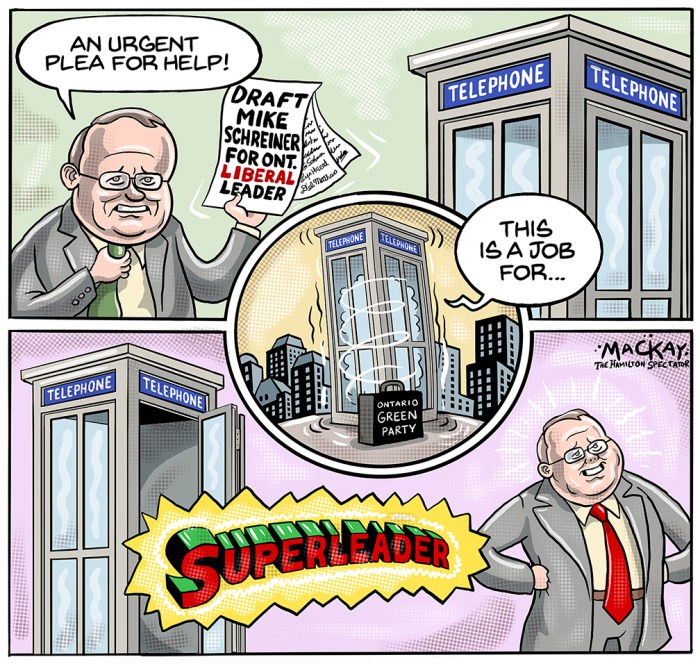
February 1, 2023 by Graeme MacKay

February 1, 2023

Editorial Cartoon by Graeme MacKay, The Hamilton Spectator – Wednesday February 1, 2023

Ontario Green Party Leader Mike Schreiner isn’t ruling out a bid for the leadership of the Ontario Liberals.

A group of high-profile Liberals — including former cabinet ministers Deb Matthews and Liz Sandals, and current Liberal caucus member Lucille Collard — released a letter Sunday urging Schreiner to join the party and run to be its leader.

October 18, 2012

“Our party needs to rediscover a politics of purpose and principle. We need to reach out to a new generation of voters. We need to open up to new people and new ideas and to embrace the kind of energy and enthusiasm that is driving grassroots activism and engagement across the province,” the Liberal group wrote.

“And that’s why we’re turning to you … We believe that your strong principle-based approach and your ability to connect and motivate activists — especially young people — is exactly what our party and province need now.”

Speaking to CBC Radio’s Metro Morning on Tuesday, Schreiner said he is mulling over the unusual proposal.

“My response is: give me time to think about this. Most importantly, give me time to consult with people — especially my constituents in Guelph and my friends and colleagues in the Green movement and people across the province — about the best way I can move forward to advance the issues I care about,” he said.

November 22, 2022

Schreiner had previously dismissed the idea when it was broached late last year, but he said the letter “really challenged” him to consider how he might “work differently” on issues like the climate crisis, housing affordability and protecting the Greenbelt.

The Liberal group argued that as Liberal leader, Schreiner would have a broader platform to rally Ontarians opposed to Premier Doug Ford’s Progressive Conservative government.

“I think I owe it to people to think about it,” Schreiner told Metro Morning.

The party has been without a permanent leader since Steven Del Duca stepped down last year following a devastating election loss — the party’s second such result in a row.

Several Liberals have publicly said they’re exploring a run at the top job, including MP and former Ontario cabinet minister Yasir Naqvi, MP Nathaniel Erskine-Smith and current Ontario Liberal caucus member Ted Hsu.

he letter and companion DraftMike.ca website are not going over well with some Liberals.

September 28, 2012

Erskine-Smith wrote on Twitter that purpose and principle are indeed needed, along with “serious renewal” in the party.

“But we don’t need gimmicks, open letters, or Hail Marys,” he wrote. “There is no substitute for hard work and grassroots engagement. We need serious leadership. For a change.”

In response to those comments, Schreiner said Tuesday that he considers the letter “genuine outreach” but that he needs time to consider his options.

Schreiner has been the leader of the Ontario Greens since 2009 and in 2018 won the party’s first seat in the legislature.

His performance in the 2022 election debate was widely praised and he is well liked at the legislature, but despite the party’s high hopes of winning a second seat in that election, the Greens remain a caucus of one. (CBC) 


Posted in: Ontario Tagged: 2023-03, Comic Book, Green, leadership, Liberal, Mike Schreiner, Ontario, party, superhero, superman

Tuesday March 3, 2020

March 10, 2020 by Graeme MacKay

Editorial Cartoon by Graeme MacKay, The Hamilton Spectator – Tuesday March 3, 2020

Here’s What’s at Stake in Super Tuesday States

Sketch from the CBS News Democratic Party Candidates Debate, Charleston, South Carolina, February 25, 2020.
Michael Bloomberg, Joe Biden, Elizabeth Warren, Bernie Sanders, Pete Buttigieg, Amy Klobuchar, Tom Steyer

The contests on Tuesday may be the single most important day on the primary calendar, with the potential to elevate one candidate as a decisive front-runner for the Democratic presidential nomination.

If one Democrat — most likely Senator Bernie Sanders of Vermont — builds a wide lead of several hundred delegates over the rest of the field, it could become exceedingly difficult for other candidates to catch up over the remaining three months of primary elections.

But it is by no means certain that Mr. Sanders or anyone else will establish a controlling advantage on Super Tuesday, and former Vice President Joseph R. Biden Jr. is hopeful that a late surge of momentum will keep the final margin close.

The vast diversity of the country and the internal divisions of the Democratic Party will be on display across a landscape of elections that covers the swollen suburbs of the Mid-Atlantic and the Sun Belt; traditional Democratic strongholds in New England and the Upper Midwest; the booming cities of the upper South and the interior West, and large rural stretches across both regions.

For any one candidate to dominate that map would be an extraordinary show of strength.

Super Tuesday 2012

It is the closest we will get, in this long campaign season, to a national day of voting in the nomination race. But the balance of influence on Super Tuesday is weighted toward the West, represented by huge states like California and Texas. Other big population centers in the country — electoral prizes like Florida, Michigan, New York, Pennsylvania and Illinois — are still weeks from voting.

Mr. Sanders is highly likely to come out of Super Tuesday with a lead in the delegate count. But the size of that lead is a big question mark, and so is the number of states Mr. Sanders might win outright.

July 31, 2019

There are few states out of reach for Mr. Sanders. In theory, he could win virtually everywhere on Super Tuesday, except perhaps Alabama, where moderate African-Americans who lean toward Mr. Biden make up a huge share of the primary electorate.

The Vermont senator has even been showing strength in Massachusetts, the home state of his rival, Senator Elizabeth Warren. He also has a chance of capturing Minnesota, which is now up for grabs after Senator Amy Klobuchar decided to exit the race on Monday. Mr. Sanders won the state in 2016.

The most important target for Mr. Sanders is California, where his campaign hopes not just to win, but to win by such a dominant margin that he captures a vast majority of delegates. If Mr. Sanders managed that feat, he could open a nearly insurmountable delegate lead.
 
Yet Mr. Sanders’s strength depends on his political opposition staying fractured. If moderate voters or African-Americans coalesce around just one or two other candidates — Mr. Biden may be the likeliest rallying point — then Mr. Sanders could end up with a shorter list of victories, concentrated in Western states where his coalition of young liberals and Latinos is strongest.
 

February 11, 2020

The race began to take a dramatic turn on Sunday after former Mayor Pete Buttigieg dropped out, clearing the way for moderate voters to coalesce around candidates who may be better positioned to stop Mr. Sanders. The exits of both Mr. Buttigieg and Ms. Klobuchar could lift Mr. Biden’s political fortunes on Tuesday, but might also benefit Ms. Warren and Michael R. Bloomberg.

Mr. Biden received the big victory in South Carolina that he was looking for, but it remains to be seen how much of a lift he will get heading into Super Tuesday. One problem: Until this past weekend, he had not campaigned in a Super Tuesday state in over a month, aside from fund-raising.

May 11, 2012

After his fourth-place finish in Iowa and his fifth-place finish in New Hampshire, Mr. Biden planted himself in Nevada and then in South Carolina — and he achieved the results he was looking for in those two states. But that came at the cost of campaigning elsewhere. He visited North Carolina, Alabama and Virginia this past weekend, and he is campaigning in Texas on Monday before heading to California.

Mr. Biden’s team is focusing on congressional districts that play to his strengths, such as those with large numbers of black voters.

Mr. Biden’s operation on the ground across the Super Tuesday states is also conspicuously thin. He has only a single office in California and four in Texas. By comparison, Mr. Bloomberg’s campaign says it has 24 offices in California and 19 in Texas.

February 6, 2008

Still, Mr. Biden has some significant advantages heading into Tuesday’s contests. He emerged triumphant from the South Carolina primary, which provided him with a burst of positive attention, and the endorsements from Ms. Klobuchar and Mr. Buttigieg offered a signal to moderate voters to embrace his candidacy. Mr. Biden already had a long roster of prominent endorsers in Super Tuesday states, which has grown even larger in recent days.

He is also relying on his status as a household name and the goodwill that remains among Democrats from his time serving as President Barack Obama’s vice president. (NYTimes) 


Posted in: USA Tagged: 2020-08, Bernie Sanders, costume, Elizabeth Warren, Joe Biden, Michael Bloomberg, primary, Super Tuesday, superman, USA

Thursday May 16, 2019

May 23, 2019 by Graeme MacKay

Editorial Cartoon by Graeme MacKay, The Hamilton Spectator – Thursday May 16, 2019

Freeland renews push to remove steel, aluminum tariffs during Washington trip

July 27, 2018

Foreign Affairs Minister Chrystia Freeland is bound for Washington to meet with Trump trade czar Robert Lighthizer in a renewed push to get punitive steel and aluminum tariffs lifted.

The meeting at the United States trade representative’s Washington office is to take place on Wednesday but Freeland will also venture to Capitol Hill for a meeting with the influential Republican chair of the Senate finance committee, Chuck Grassley.

“We continue to lobby very assertively for the lifting of the tariffs. We’re at a point where we need to do everything we can and talk to everyone we can about why we see these as unjust,” a senior government source said Tuesday, speaking on the condition of anonymity because of the sensitivity of the ongoing dispute.

June 1, 2018

The meetings come after a pair of telephone calls on consecutive days late last week between President Donald Trump and Prime Minister Justin Trudeau, in which the controversial 25-per-cent duty on Canadian steel and 10-per-cent levy on aluminum was a major subject of conversation.

On Tuesday, Grassley suggested to reporters in a conference call that an end to the tariffs might be close. Last month, Grassley tweeted that Trump must remove the tariffs before the new North American trade deal can be ratified.

Trump imposed them in the first place using a section of U.S. trade law that gives the president powers to put duties on imports on national-security grounds.

Freeland, Trudeau and others in Canadian government have derided the tariffs as absurd, illegal and insulting.

But Freeland has said she’s heartened by the recent comments of both Republican and Democratic American lawmakers who say the new North American trade agreement that includes Mexico can’t be ratified with the “Section 232” tariffs in place. (Global)


Posted in: Canada, USA Tagged: 2019-18, beaver, Canada, Chrystia Freeland, diplomacy, Donald Trump, man, steel, Steven Mnuchin, superhero, superman, tariff, Trade, USA
1 2 Next »
...Check it out and please subscribe!

Your one-stop-MacKay-shop…

T-shirts, hoodies, clocks, duvet covers, mugs, stickers, notebooks, smart phone cases and scarfs

2023 Coronation Design
Follow Graeme's board My Own Cartoon Favourites on Pinterest.

MacKay’s Virtual Gallery

Copyright © 2016 mackaycartoons.net

Powered by Wordpess and Alpha.

DMCA.com Protection Status
Loading Comments...